
Your people aren’t resisting change. They’re simply tired.
It’s an important difference – and most leaders don’t see it. In recent years organisations have gone through the pandemic, the hybrid model, waves of restructuring, AI system rollouts, strategy changes and new board priorities. Each of these initiatives was important. Each was urgent. Each required people’s commitment.
And people gave it their all. Really.
But adaptive resources have their limit. When yet another initiative is met with silence in the room, eyes fixed on the floor or the sentence “so we’re implementing something again…” – that isn’t resistance. It’s a signal of overload. It’s change fatigue.
This article answers three questions: how to recognise change fatigue in your team, why it happens and – above all – what you as a leader can do right now.
1. What change fatigue is and how to recognise it
Change fatigue is cumulative exhaustion resulting from too much change – not from one big transformation, but from overlapping initiatives that don’t give the team time to fully adapt.
In organisations it shows up on several levels at once:
Signals of change fatigue in a team
→ The team follows instructions, but without energy or commitment
→ Jokes or cynical comments appear about “yet more initiatives”
→ People ask “what for?” – not out of curiosity, but out of fatigue
→ The best employees start looking around for something more stable
→ The quality of work drops – not skills, but the motivation to be thorough
The key point is that change fatigue isn’t a weakness in people – it’s a natural reaction of the nervous system and the psyche to overload that has lasted too long. Understanding this changes a leader’s perspective: instead of asking “why don’t they want to?”, they start asking “what do they need right now?”.
2. Why it happens – the mechanism of overload
Every change has a cost. The problem starts when the bill exceeds the resources.
The brain treats change as a threat – not because people are inflexible, but because every new situation triggers vigilance, requires processing information and consumes cognitive energy. This isn’t a metaphor – it’s neurobiology.
Under normal conditions, the body and mind regenerate according to a natural cycle:
CHANGE → ADAPTATION → STABILISATION → READINESS for the next change
The problem arises when there’s no time to complete this cycle. The phase of stabilisation and recovery is pushed out by the announcement of the next initiative. The result is predictable:
The pattern of cumulative overload:
→ Change A is still under way
→ Change B is announced
→ In the background, change C from a year ago is still unfinished
→ People don’t know where they stand
→ Adaptive resources run out – survival mode switches on, not development mode
From our practice: we worked with a team that, within 18 months, went through a merger, an ERP system change and a structural reorganisation. Each initiative was well planned. Each had a schedule and a sponsor.
But nobody added up the bill.
When we came to that organisation, people weren’t asking “how do we implement this?”. They were asking “when will it end?”. That is the moment when change stops being a project – and becomes a source of chronic stress.
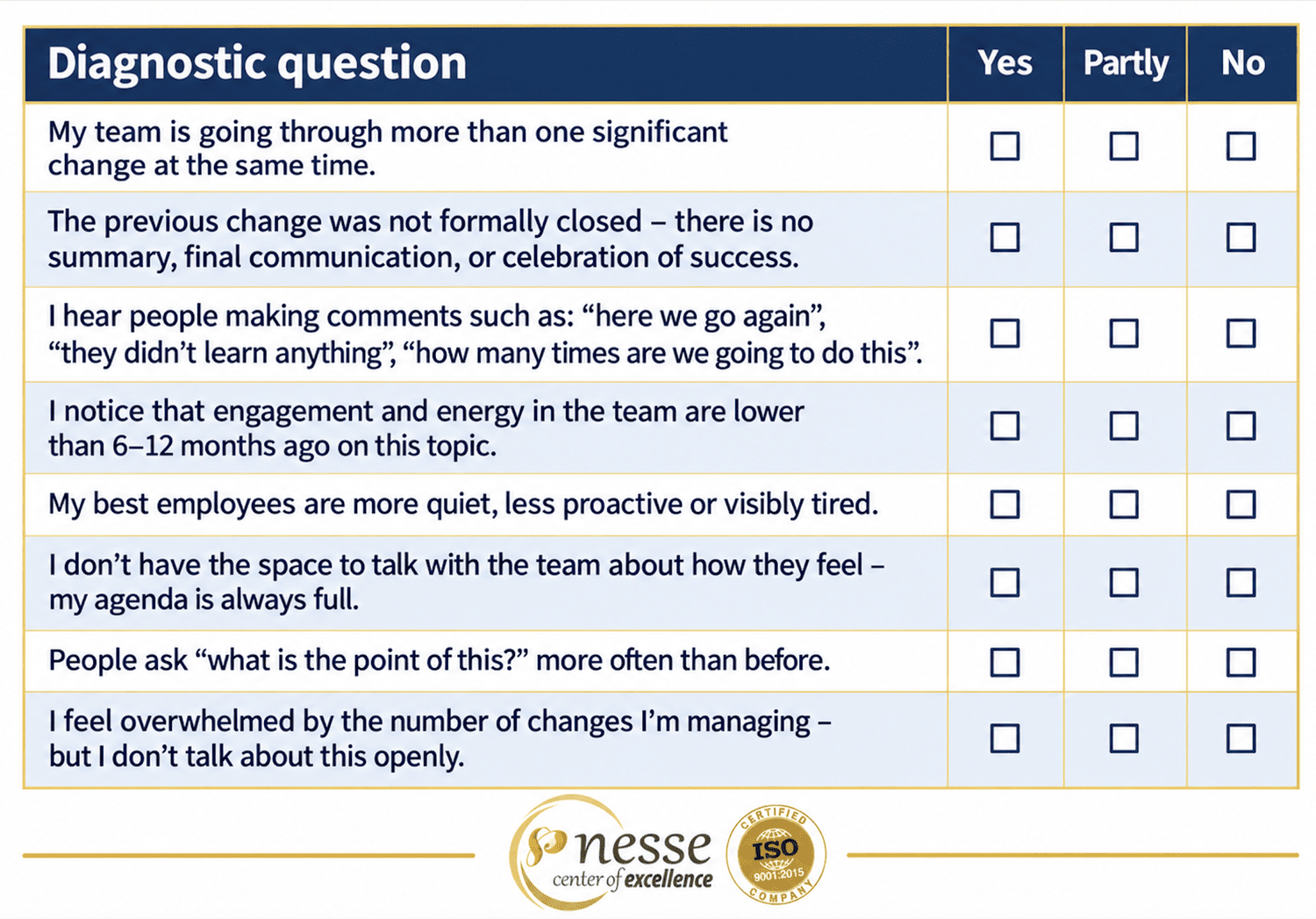
3. Self-assessment for leaders – does your team have change fatigue?
The following set of questions will help you assess how exposed your team is to change fatigue. Answer honestly – based on what you have observed over the last 3–6 months.
How to interpret the results?
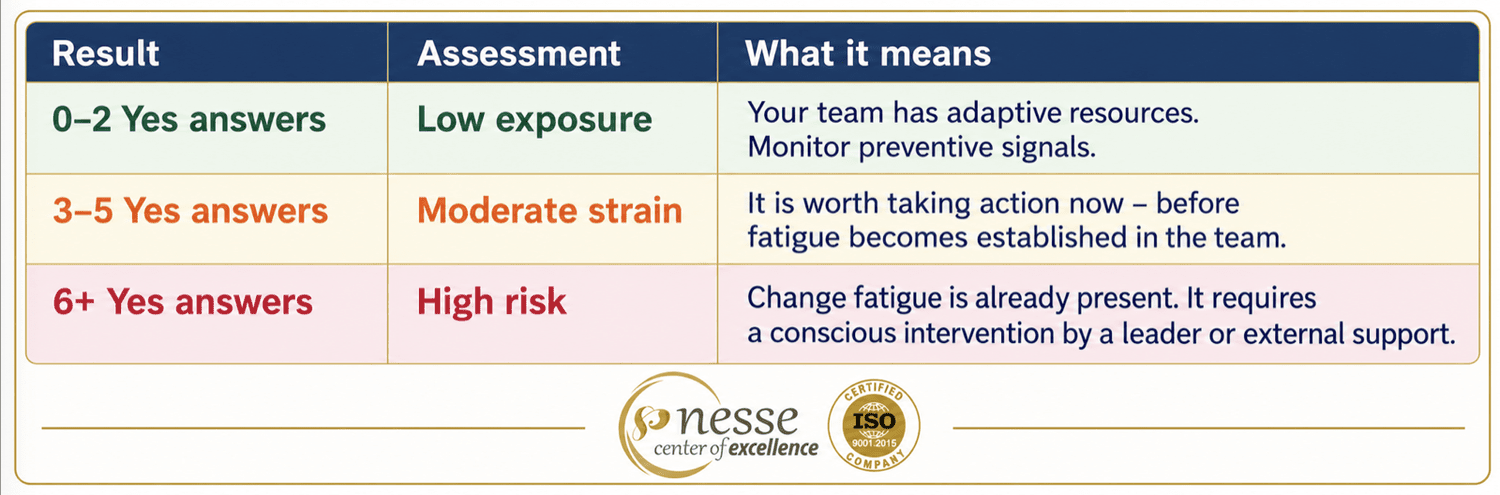
An important note: the self-assessment is indicative. Its aim isn’t to label the team, but to prompt the leader’s reflection – and possibly to take action before fatigue becomes a permanent feature of the organisational culture.
4. What a leader can do – 4 behaviours that genuinely work
A leader doesn’t manage change. A leader manages people’s energy in change.
This shift in perspective changes everything. Most change management training focuses on how to plan, communicate and implement change. That matters – but when the team is overloaded, good communication alone isn’t enough. At that point, people don’t need another deck with a roadmap. They need a leader who sees that they are tired.
1. Close what is open – before you open something new
Before every new initiative, ask yourself: what from the previous change is still unfinished? Unaccounted-for projects, suspended decisions, promises without answers – these are what drain the team’s energy, even if nobody talks about them out loud any more. Formally closing a change – a summary, a message, a moment of celebration – isn’t bureaucracy. It’s a psychological release of resources.
2. Name the overload directly
One sentence: “I can see the last few months have been intense. It’s normal that you’re tired.” Without dramatising. But said out loud – it makes a difference. People stop hiding their fatigue the moment the leader gives them permission first. It doesn’t weaken authority – it strengthens trust.
3. Protect stable points
In every change, leave something unchanged – the rhythm of meetings, the way of reporting, the structure of the working week. This isn’t resistance to transformation. It’s an anchor that gives a sense of security when everything else is moving. Research in organisational psychology shows that a sense of control over even one area significantly reduces stress reactivity in the others.
4. Ask about resources, not just results
Instead of: “How’s the rollout going?” – try: “What is making it hardest for you right now?”
The difference seems small. The effect is completely different. The first question keeps the conversation within the project. The second opens it up to what is really blocking progress – and signals that the leader is interested in the person, not just the status of the task.
5. One question worth asking today
A diagnostic question for the team:
“What is taking up most of your energy right now – but not moving us forward?”
Ask it at your next meeting. No agenda around it. Just listen.
What you hear will tell you more about the condition of your team than any implementation report.
Change fatigue doesn’t disappear when the project ends. But a leader who sees it, names it and manages it consciously builds something more lasting than a smooth rollout: the organisation’s capacity for the next changes.
And that is the most important leadership competency in an organisation that will never stop changing.
How can we support you?
If this article reflects what you are seeing in your organisation, we can talk about what form of support would best fit your situation.
Coaching
Individual work with a leader – for those who themselves feel the weight of managing under overload.
Mentoring
For leaders looking for an experienced partner to reflect on strategy and people in change.
Training
A workshop programme for management teams – how to lead people through change when resources are running out.