

HR’s annual summary. On the slide, numbers to be proud of: 47 training days, 280 people trained, an average satisfaction score of 4.6 out of 5. The board nods.
And then comes the question that none of these numbers answer:
“Fine. And what has changed on the shop flooras a result?”
And there is silence. Because the truth is that a full training calendar and behaviour change are two different things – and most organisations measure the first, hoping it means the second.
This article is about how to stop buying activity and start buying results. No academic theory – with criteria you can count.
The full-calendar trap
Let’s stop for a moment at the numbers from the beginning. Number of days, number of people, satisfaction score. They all have one thing in common: they measure that the training happened and that people liked it. They don’t measure anything that happens the next day, when the participant goes back to their workstation.
That’s no coincidence. It’s the result of how the training was ordered.
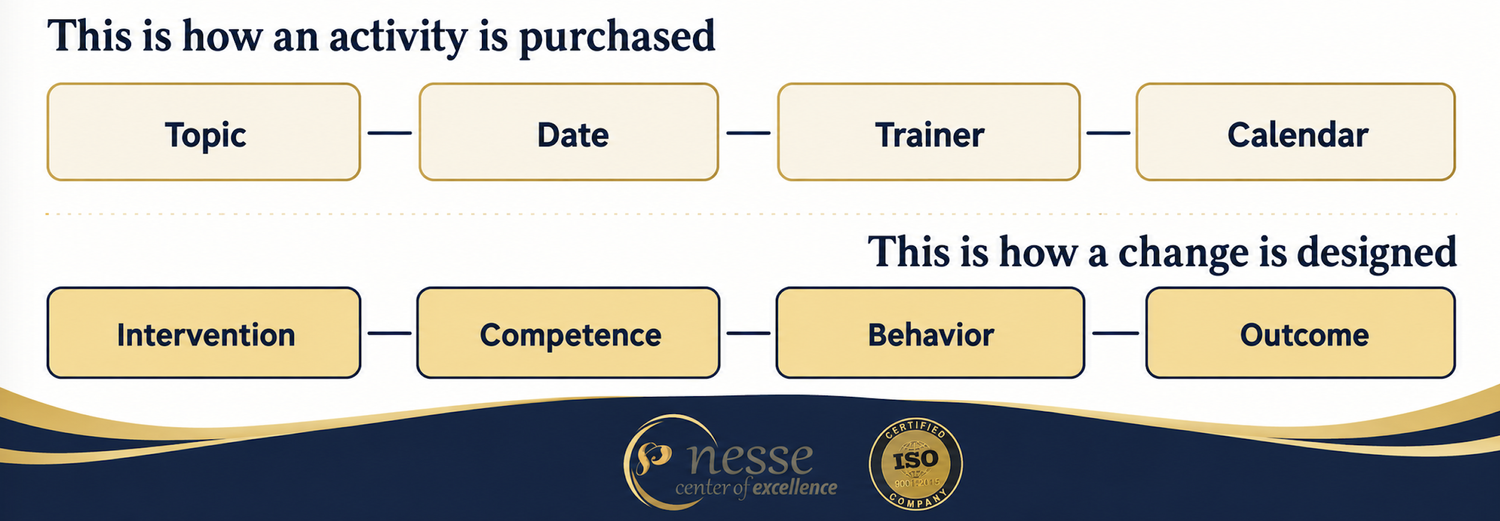
The default way of buying development looks like this: a topic comes up (“we need something on communication”), a date is found, a trainer chosen, a room booked. The criterion of success – unspoken, but real – is: did it happen and were the ratings high. That is a contract for activity. Behaviour change was never in the specification, so it’s hardly surprising it doesn’t happen.
A high satisfaction score can even be misleading. A great trainer, good energy in the room, happy people – and zero impact on how a foreman holds a conversation with an employee three weeks later. Satisfaction measures the experience in the room. It doesn’t measure transfer.
Reversing the sequence: Outcome-First
The Outcome-First approach comes down to one simple change: you start from the end.
Instead of the typical sequence topic → date → trainer → hope, you build it the other way round:
Business result → Behaviour → Competency → Intervention
That means:
What result needs to improve? (e.g. lower turnover of new operators, fewer escalations, better audits)
What behaviour needs to appear for that result to move? (e.g. the foreman responds to a problem immediately instead of escalating it)
What competency is missing for that behaviour to be possible? (e.g. holding a corrective conversation)
Only now do you choose the intervention – and it isn’t necessarily training. Sometimes it’s a process change, sometimes a conversation with the manager, sometimes coaching.
Note the consequence: in this logic, training stops being a product and becomes a tool for a specific result. And a tool that doesn’t work gets replaced – not repeated every year in hope.
A test before you buy
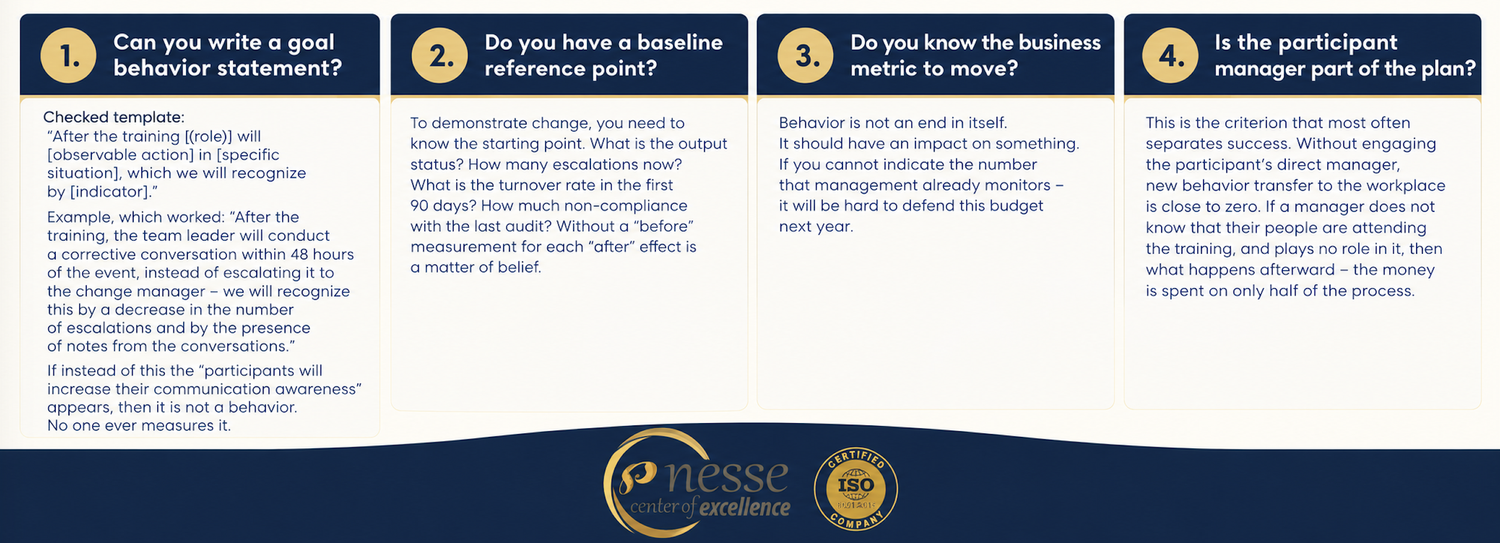
The cheapest moment to stop a bad training programme is before it is ordered. Below are four questions. If you can’t answer even one of them, you’re buying activity, not change.
Measurable criteria: four levels
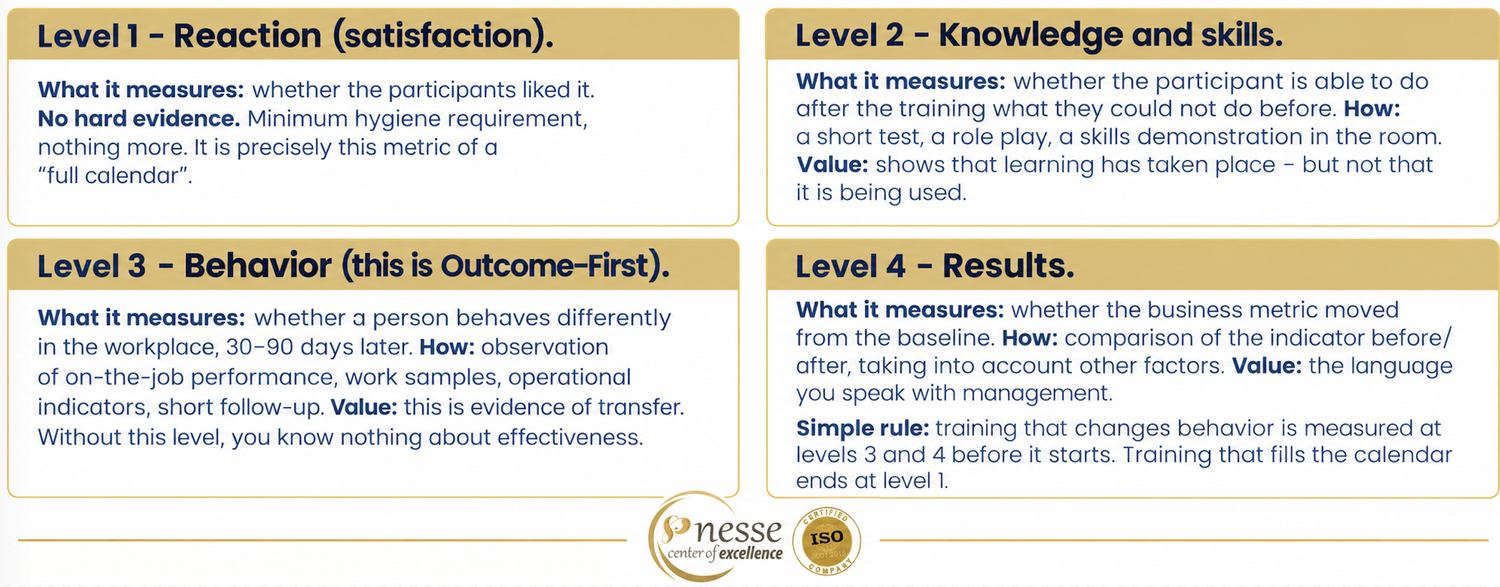
Here’s the heart of it – how to really tell one training programme from another with numbers. You can measure on four levels. Most organisations stop at the first and mistake it for the whole.
What exactly should you measure in a manufacturing environment?
So that this doesn’t remain abstract – here are indicators that genuinely respond to changes in managers’ behaviour and are suitable as a baseline:
Turnover of new employees in the first 90 days – sensitive to the quality of foremen’s leadership and onboarding.
Time for an operator to become independent (time-to-competence) – responds to the quality of instruction and feedback.
Number of escalations to the shift manager or higher – falls when the lower level genuinely takes over decisions.
Audit non-conformities and complaints – a derivative of discipline in standards, shaped by everyday leadership.
Frequency of 1:1s and feedback – a leading indicator for any leadership training; easy to count.
Readiness for internal promotion – how many people we have genuinely prepared, instead of looking outside.
Absenteeism and accident rate – sensitive to the team climate and the quality of the relationship with the line manager.
You don’t need all of them. You need one or two that link to the target behaviour statement from the test above.
The part everyone skips: after the training
This is where the difference between an expense and an investment is decided. Behaviour doesn’t change in the training room – it changes in the first weeks after returning, when the old habit fights the new one. If nothing happens during that period, the habit wins. A minimal, realistic “after” plan:
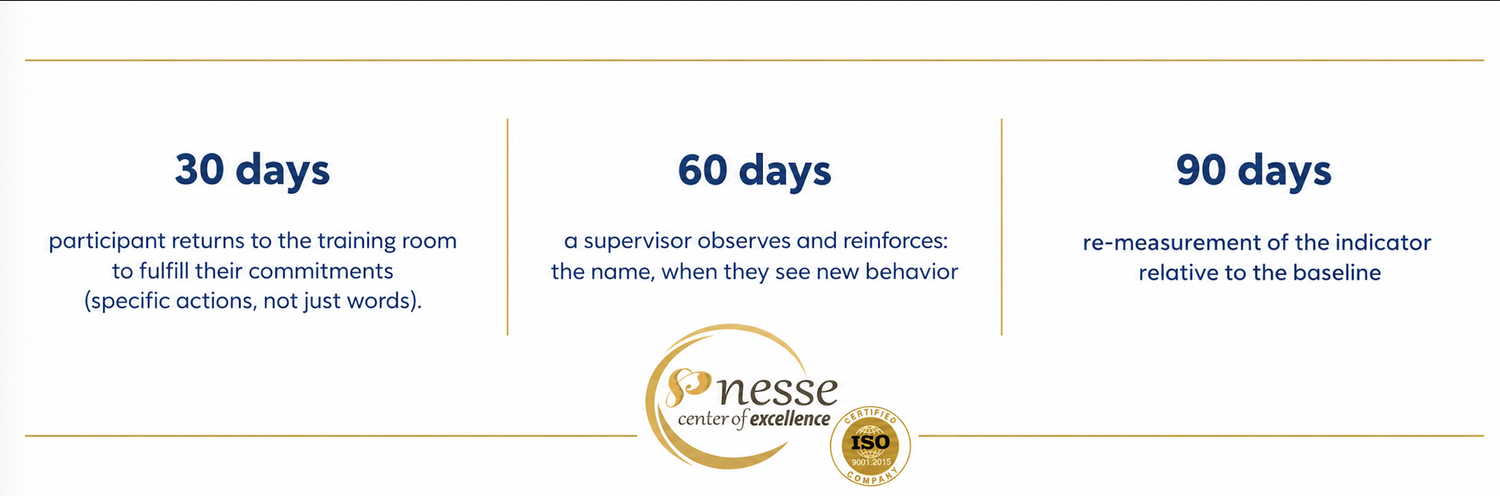
This doesn’t require a big apparatus. It requires planning it before the training, rather than counting on it “somehow making its way into practice”.
Finally: what are you really buying?
The most important change is mental. In the Outcome-First model, you aren’t buying training. You are buying changed behaviour and a metric that moves – and training is just one of the possible ways to achieve them.
This change of perspective does two things at once. First, it filters out apparent development – the kind that fills the calendar. Second, it gives you a language for defending the development budget in front of the board, not with the number of days, but with a number they care about.
If you are planning development for the second half of the year and want every zloty invested to be assigned a specific behaviour and indicator, this is exactly the moment to design it consciously.