
A scene worth seeing
In the Polish IT sector and beyond, more and more people work in a distributed model – several projects, changing contracts, no continuity of employment. This isn’t the margin of the labour market. It is increasingly its everyday reality.
And in this everyday reality, well-being has become topic number one. HR reaches for digital tools: meditation apps, stress tracking through wearables, personalised micro-exercises. Accessible, fast, cheap.
Let’s freeze the frame on this trend – because there is something important and something worrying in it at the same time. And it’s worth saying both plainly.
Where micro-habits really work
Let’s start with what’s fair: these tools have real value. Not everything is a sham.
A moment of pause in the middle of chaos
Two minutes of breathing exercise before a difficult meeting – so-called box breathing – isn’t a placebo. Studies show a reduction in subjectively perceived stress of between a dozen and several dozen per cent with regular use. In an environment where switching between projects takes minutes rather than hours, such a pause matters.
Personalised support through data
New generations of tools track patterns of activity, sleep and heart rate. They can suggest a break before a person notices they need one. For people who struggle to recognise their own signs of exhaustion – and there are more of them than we think – this can be a valuable complement to self-awareness.
Accessibility without an entry barrier
In distributed, project-based teams there is no single place, single HR person or single organisational culture. An app works everywhere and for everyone. It levels access to basic resources – for people who in a different model would have no support at all.
Data from the pharmaceutical sector
In contract-based structures in the pharmaceutical industry, pilots with micro-habits showed an increase in subjectively assessed productivity of a dozen or so per cent. It isn’t a revolution – but it is a signal that the tool has its place.
“Sometimes the greatest tool isn’t the one that solves the problem completely – but the one that keeps you from collapsing until you find the right solution.”
Where an app stops being enough
And here begins the part we most often skip in conversations about well-being. Perhaps because it’s harder. It doesn’t require buying a subscription, but changing decisions.
A structural problem won’t disappear with breathing
Unstable contracts, lack of social protection, irregular income, chaos with invoicing – these aren’t emotional states to be worked through. They are systemic conditions. An app that helps you “accept uncertainty” doesn’t address the fact that your contract ends in two months and nobody knows what comes next.
Well-being built solely on individual coping strategies is fragile. Not because people are weak – but because the load is excessive.
Apps don’t know the Polish context
Digital tools are mainly built on data from large Western corporations from 2020–2025. They don’t understand the specifics of the Polish market: the chaos of social security contributions for the self-employed, invoices paid within sixty days, the lack of holiday pay in project contracts. That isn’t a detail. It’s the everyday reality of thousands of specialists.
The flattery trap
“You’re amazing. You made it through another day.” Messages like this create a momentary good mood – and avoid confronting the question that’s really worth asking: are these working conditions right for me? Does this client respect me? Is this situation acceptable?
Mental resilience doesn’t grow from flattery. It grows from the ability to assess a situation – and take action. An app that never says “maybe it’s time to change something” doesn’t support development. It supports survival.
The risk of well-being washing
This is a phenomenon we observe with growing concern. An organisation rolls out a mindfulness app – and stops the conversation about working conditions there. A subscription replaces a stable contract. Meditation replaces predictable income. That isn’t care for people. It’s care for the image of caring for people.
“What looks like support on the surface can be, underneath, a quiet acceptance of a state of affairs that needs to change.”
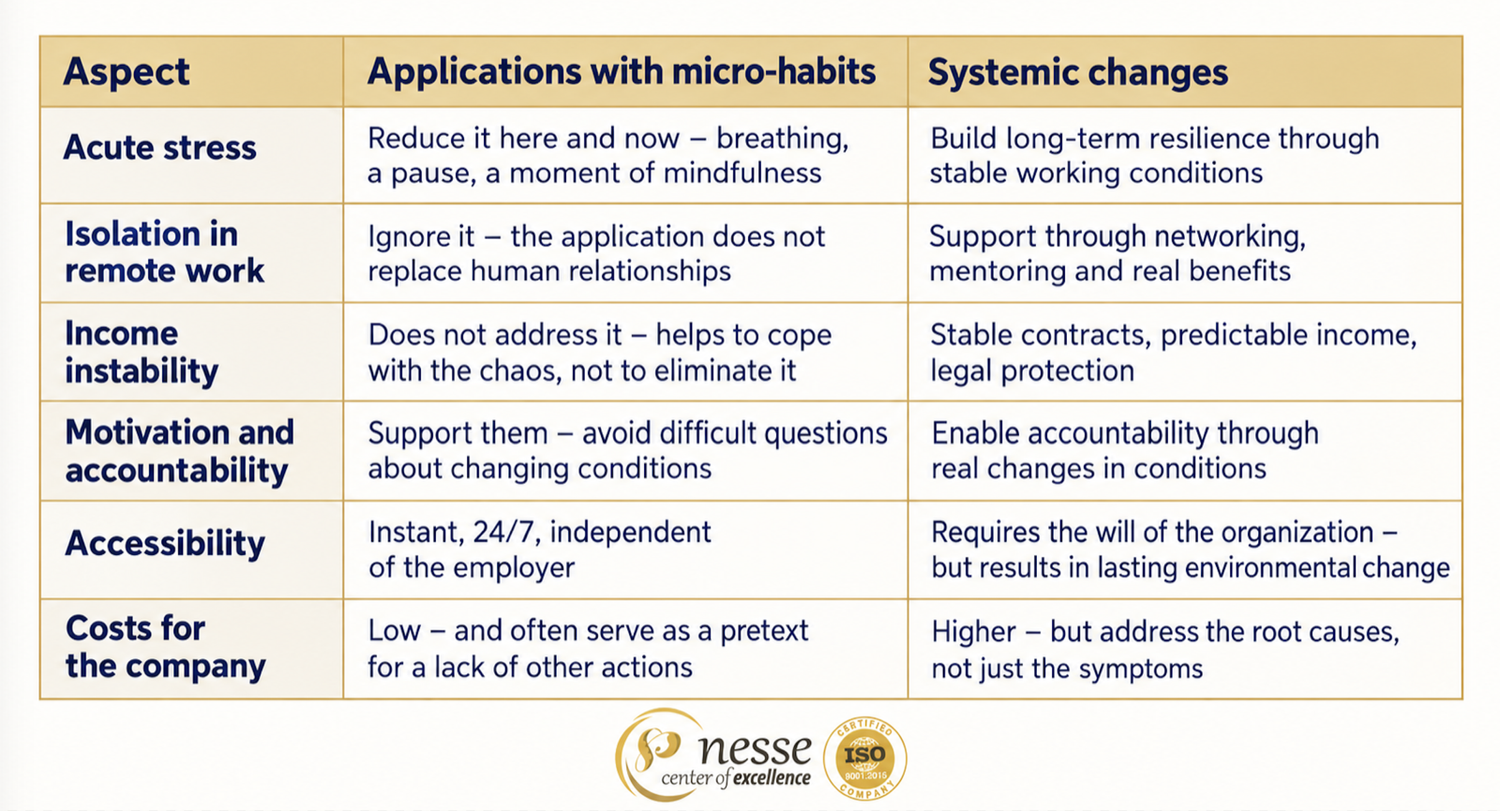
Apps vs systemic change – what are we really comparing?
Let’s pause on one sentence
An example from a recent conversation with someone working on projects in IT. They said: “The app taught me to breathe. But nobody taught me how to tell a client that their terms are unacceptable.”
Let that sentence stay with us. Because it shows exactly where the tool ends – and where something begins that no app can replace: a sense of agency. The ability to set a boundary. Permission to say “no”.
That isn’t built with a five-minute exercise. It’s built through relationships, through safety, through an environment that allows it.
Recommendations for HR departments and organisations
We aren’t suggesting giving up digital tools. We suggest embedding them consciously in something bigger.
A hybrid model – tool plus policy
– Micro-habit apps as ad hoc support – not as the only answer to well-being needs.
– A clear organisational policy: a project contract must include minimum protection – time for recovery, predictable invoicing, access to support.
– The principle: no form of cooperation without basic security. Well-being starts with conditions, not apps.
An audit of systemic barriers – before you roll anything out
Before you buy a subscription, do one exercise with your team: list the systemic barriers that generate stress. Irregular income, lack of project continuity, isolation in remote work. Check which of them you can change. Only then choose tools for what can’t be changed.
Measuring what matters
It’s worth assessing the effectiveness of well-being programmes not by the number of app downloads, but by real indicators: turnover in contract-based structures, the declared stability of a sense of security, the quality of relationships in distributed teams.
“We don’t need more tools that help us survive difficult conditions. We need the courage to ask – should these conditions be so difficult at all?”
Finally – a question worth asking yourself this week
If you work in HR or leadership: does the well-being you offer your team address the real causes of stress – or only its symptoms?
There isn’t one correct answer here. But simply asking the question changes the perspective.
And you? Where in your organisations do micro-habits really help – and where do you feel that something more important remains unaddressed?