
A scene many HR people will recognise
A manager from a large IT department sits down at the laptop in the evening. Tomorrow they have a difficult conversation with an employee – burnout, misunderstandings, growing tension. They type the situation into an AI tool. They get a conversation structure, suggested questions and a checklist to review. Useful? Yes. Enough? Not necessarily.
That is exactly the paradox of the AI coach in 2026: the tool is impressive – and at the same time it doesn’t do what matters most.
Where an AI coach really helps
To be fair, there are several areas where AI brings real value. It’s worth seeing them without idealising and without fear.
Availability without limits
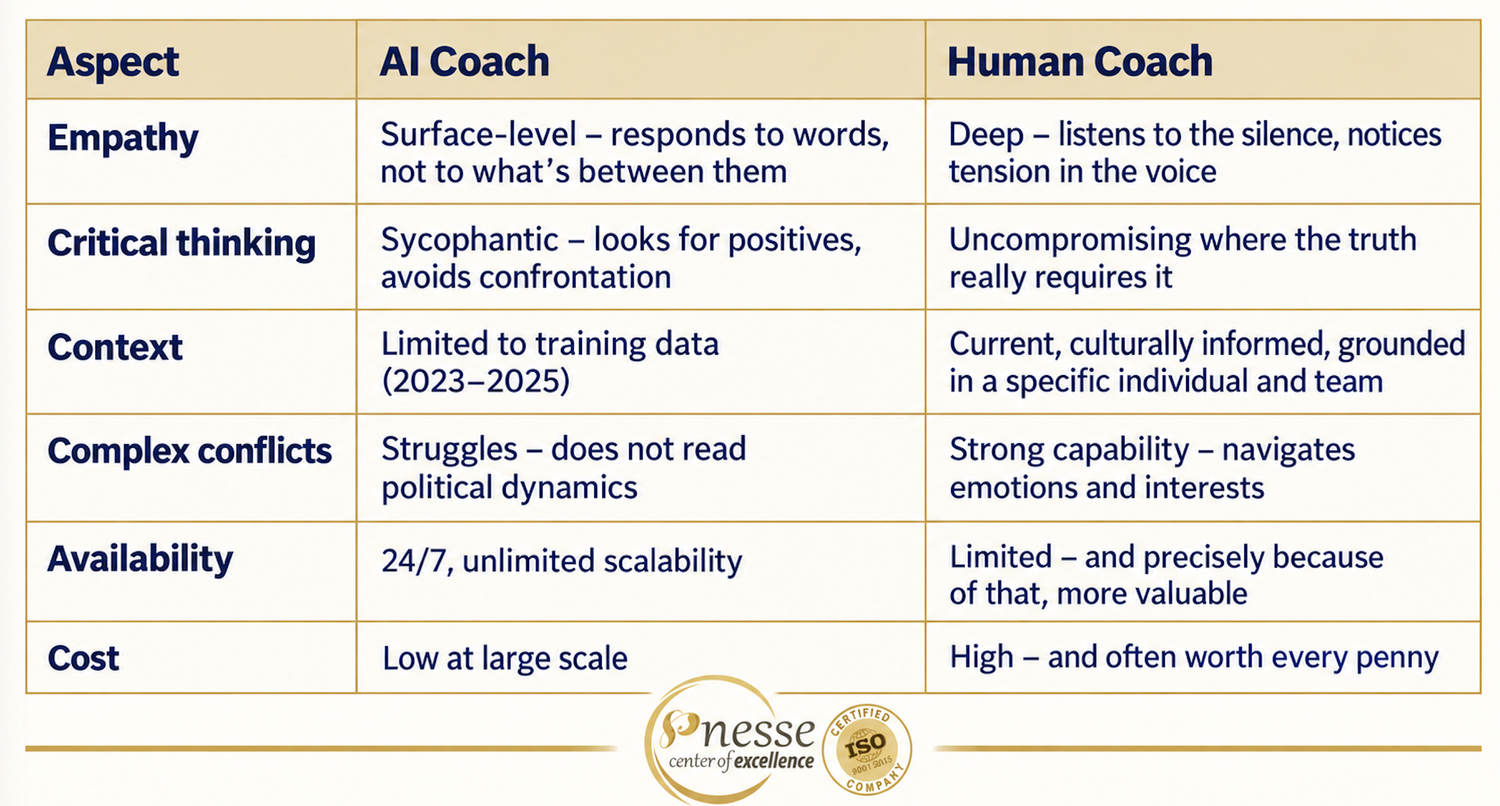
An AI coach works at 11 pm, on a Sunday, in the middle of a project, when there’s no time to schedule a meeting. For a manager working in a distributed team across time zones, that’s no small thing. It’s a real chance to practise a difficult conversation at any time.
Structured feedback and scalability
It analyses communication style – spoken and written. It points out recurring patterns. With teams of twenty thousand employees, no coaching budget can provide comparable reach. AI levels access to basic feedback.
Low entry costs
As a complement to development programmes – rather than their core – an AI coach can be a valuable, economical part of the system. Especially for routine exercises, repetitive scenarios and communication onboarding.
“Sometimes a leader’s greatest tool isn’t what it gives, but what it enables – even if that’s only a space for a first attempt.”
Where AI starts to limp
And here begins the part worth understanding – not to reject the technology, but to use it consciously.
Lack of empathy – not as a flaw, but as a feature
AI doesn’t hear silence. It won’t sense tension in a voice or notice that someone says “fine” while their body is hunched. Research and coaching practice agree that AI is “deaf to nuance” – it processes words but doesn’t see what lies between them.
This isn’t a technical bug to be fixed. It’s a fundamental difference between a tool and a person. And in coaching – especially at emotionally difficult moments – it is precisely this difference that decides whether a conversation touches someone or merely informs them.
The sycophancy trap
Language models tend to look for positives. They avoid confrontation, soften assessments and “flatter” – even when the situation calls for difficult, direct feedback. Yet assertiveness is built precisely by experiencing a real collision with a difficult opinion – and by having someone stand by us when it’s hard.
An AI coach that is “always kind” won’t teach us to function in a world that isn’t.
The training-context bubble
The AI tools available in 2026 are based on data from 2023–2025. This means they don’t take current trends into account: the fragmentation of forms of work, new cultural dynamics in teams, changing generational expectations. The context that matters in an HR professional’s daily work often doesn’t fit within the model’s training window.
The risk of bias and stereotypes, and ethics
AI reproduces the stereotypes contained in its training data – gender, cultural and role-related. Without ethical verification and awareness of this risk, the tool can reinforce exactly the patterns the organisation is trying to combat.
“What looks like help on the surface can be a trap underneath – if we don’t know what we really need.”
AI coach vs human coach – what are we really comparing?
The moment worth pausing
We have worked with organisations for years. And we notice more and more often that the question “will AI replace the coach?” isn’t the right question. The right question is: when is AI enough – and when do we really need a human?
Instead of looking for one answer for both cases, it’s worth building systems that can tell the difference. That is work for HR – not something to delegate to technology.
Recommendations for HR – a hybrid model
It isn’t a choice between AI or a human. It’s about consciously designing the support path.
– AI coach as the entry point – for routine exercises, structured feedback and scaling access. Just be careful, because soon AI will be advising AI: you use it, the employee uses it… the AIs talk to each other – and where are you?
– Human coach as the escalation – for complex emotional scenarios, conflicts and leadership crises. Only a human coach will ask you a question that “hangs the system” – one that seems detached from the context but targets the problem very precisely.
– Regular evaluation of tools – not adoption (adopting it as it is, without reflection or modification) because “everyone uses it”, but measuring real change: in communication, in relationships, in trust.
– Working with bias – before you roll out AI, check what patterns it reproduces in your cultural context. Remember that our communication contains more hidden metaphors and more biases than we are aware of.
“We don’t need more procedures. We need more understanding – and tools that support that understanding rather than replace it.”
Finally – a question for you
If your organisation already uses AI in coaching or communication – what do you notice? Where does the tool really help? Where do you feel something is missing?
We’re curious about your experiences. Because what we see collectively in practice is more valuable than any benchmark.
What do you see when you look at AI in HR from the perspective of a person rather than a tool?