“A leader doesn’t raise people – a leader builds space”
Imagine the situation: the boss comes over and says, “I did it for you, because I knew you’d find it difficult.” Or: “Don’t worry, I’ll talk to that department so you don’t get stressed.” Sounds caring? Perhaps. But what if behind that care there is a leadership style that resembles a parent–child relationship more than an adult–adult one?
In times of organisational transformation, when there is more and more talk of empowerment, partnership and accountability, the role of the leader-guardian becomes outdated – and sometimes downright harmful.

The leader as parent: a tempting trap
Many companies still operate a management model that could be called “caring-authoritarian”. The leader is the one who knows better, judges, hands out rewards and punishments, and their intention is often to protect the team from difficulties, stressors or uncertainty. All in good faith. Unfortunately, it is a relic of the belief that a company is one big family.
But this model – even if it worked in the 20th century – does more harm than good today. It raises a team that doesn’t learn accountability, waits for instructions, seeks approval and becomes emotionally dependent on its leader. In the leader, meanwhile, it builds a sense of omnipotence, which shows up as:
not listening to others, because “I know better”
aggression towards feedback: “how dare you say that to me, your boss” and “nobody has the right to judge me”
a need to control absolutely everything, slipping into micromanagement
the belief that “the world is wrong, I know better” – a direct route to a God complex
Transactional analysis: who is speaking here?
Eric Berne, the founder of transactional analysis, distinguished three main ego states:
Parent – critical or nurturing, full of rules, morality or care.
Adult – rational, analytical, based on the “here and now”.
Child – spontaneous, emotional or compliant.
In organisations that call themselves “family” companies or say they have a “family atmosphere”, we often observe Parent–Child transactions:
The boss as Parent cares, lectures and keeps watch.
The employee as Child asks for permission, avoids responsibility and expects praise.
This pattern may seem functional – but only in the short term. Because it leads to a lack of autonomy, frustration and a sense of entitlement in the team, and in the leader to fatigue, burnout and overload. Later, the tired boss comes and says “my people have no initiative”, “my people aren’t engaged”, “my people can’t work independently”. Then I ask: “And do you, the boss, treat them as adults? Or as children?”. Of course they answer that they treat them as adults, but they don’t notice the micro-messages that put employees in the position of a child.
A mature leader is an Adult
Mature leadership means operating from the Adult state – and inviting the team into the same space. That means:
Clear rules and expectations instead of hints and emotional pressure
Decisions made together, not “for the child’s own good”
Support without doing things for people
Feedback instead of rewards and punishments
It isn’t about coldness or distance – but about respect and a partnership approachthat supports the development of every team member.
Putting up a “family atmosphere” sign in the company’s narrative automatically suggests that roles will appear: child, mum, dad, cousin, brother, aunt, grandma, etc… It’s hard to build partnership relationships within an implied family structure.
Not to throw the baby out with the bathwater… in family businesses where members of one clan work together, partnership relationships and mature leadership are possible, but they require a specific set of skills.
Soft skills needed for a partnership style
To run a company, even a family company, from the Adult state, a leader needs a set of competencies that can – indeed must – be developed:
Assertiveness – the ability to say “no” and set boundaries, including with the team.
Empathetic communication – understanding emotions without taking them on.
Conflict management – allowing the team to resolve tensions independently.
Handing over responsibility – not only delegating tasks, but also accepting mistakes.
Reflectiveness – awareness of one’s own tendencies (am I slipping into “Parent” mode right now?).
It becomes a tragedy when the leader of such a company decides that, as the head of the family who built the company and grew it to its current level, they already have a sufficient set of competencies and don’t need to learn. Let’s generalise: people who say they no longer need to learn are “dangerous”.
Stepping out of the natural parent role takes considerable self-discipline, especially as the team sometimes doesn’t want to become independent.
And what if the team demands a parent?
It’s a common scenario, especially in organisations going through transformation. Employees may expect the leader to “take care of them” – resolve conflicts for them, take responsibility, decide. Except that:
Giving in to such expectations means reinforcing their dependence
The leader’s answer should be: “I understand it’s difficult. What solutions do you see?”
It’s worth supporting – but not rescuing. That’s the difference between being a leader and being a “saviour”.
Micromanagement vs accountability
In practice, it looks roughly like this:
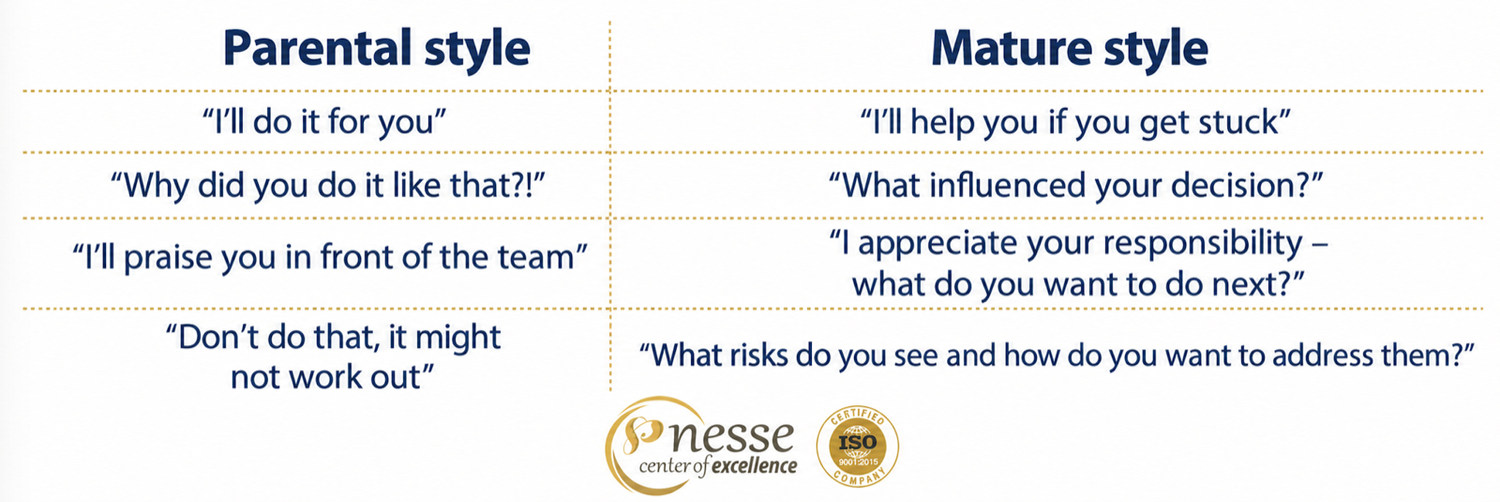
So what should you remember and stick on the fridge?
A leader isn’t a parent.
It isn’t their job to love unconditionally, protect from the world and say what is good and what is bad.
A leader is a guide who gives space to grow, not one who protects people from adulthood. Because it’s precisely in that space that great things happen: development, accountability, change.