
Can you build relationships at work without emotional blackmail?
When we hear “contract”, an alarm goes off in many of us: “so it’s cold, soulless, just duties!”. Especially if we contrast it with another, still popular metaphor – the company as a family, where warmth, care and unconditional loyalty supposedly reign.
But what if we said: it is precisely a clear agreement – not emotional closeness – that gives real security and room to grow?
In a family, things happen “on someone’s word” – and employment terms agreed “on someone’s word” can disappoint as soon as the first salary arrives.

A contract is more than paper
When we talk about a contract, we mean something more than a document from HR. We mean a psychological and organisational contract – that is:
Clarity about roles, responsibilities and expectations.
Predictability in action – we know how we react in different situations.
Agreed rules for cooperation, development and feedback
Mutual respect and… yes, empathy – but not forced by emotional blackmail of the “you have to love daddy” kind.
Such a model not only gives a sense of fairness but also reduces the emotional chaosthat often accompanies a “family” culture.
Could it be too cold?
Of course – a contract reduced to a pure transaction (“you do X, I pay Y”) can drain relationships. That is why it is crucial to distinguish between two approaches:
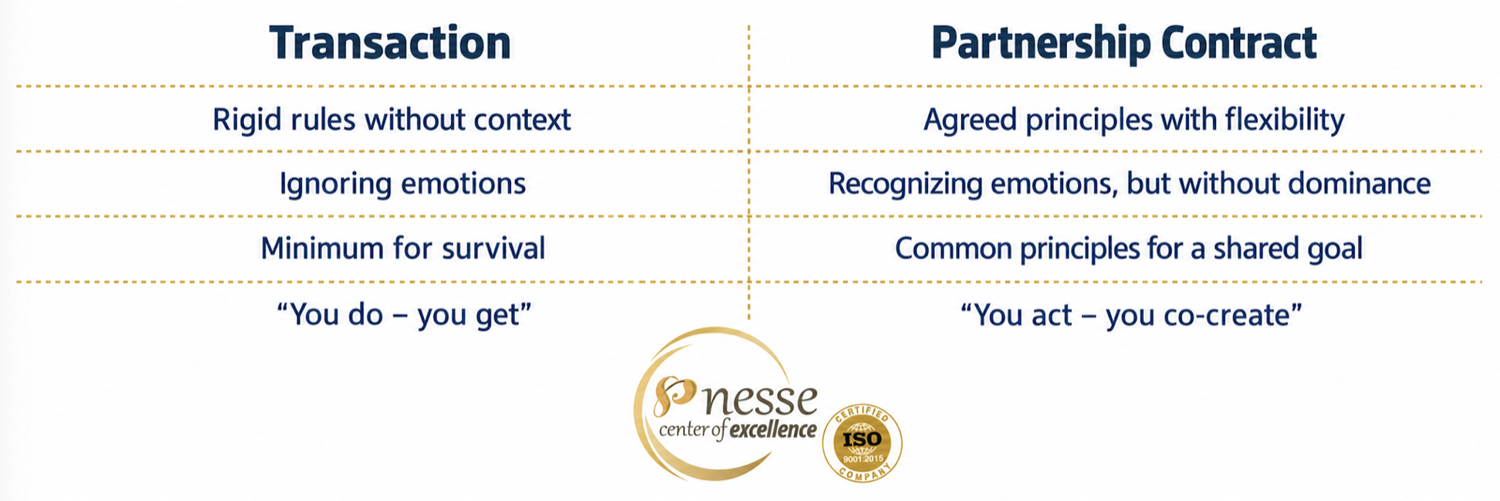
So the point is not to get rid of relationships, but to root them in mature structures, not in vague expectations or emotional dependence.
What does the contract model give you?
Surprisingly much good – as long as it is well looked after:
1. Security and predictability
People know what is OK and what isn’t. There is no need to read “the leader’s moods” or adapt to a “culture of unspoken rules”.
2. Professionalism and equality
Everyone has the same rules of the game, whether they are a “favourite” or not. “Family nepotism” comes to an end.
3. Resilience to conflict
In a family company, a quarrel can be the end of a relationship. In a contract-based organisation, it is the start of a dialogue and an update of the rules.
4. Room for development and autonomy
Instead of “blind” loyalty – a fair exchange: we support your development, we expect your contribution.
How to communicate rules without losing empathy?
The key here is leaders’ communication skills and emotional intelligence. Here are some practices:
Rules we create together, rather than “imposing them from above”
Clarity, but not harshness – “this is how it works” instead of “because that’s how it has to be”
Feedback anchored in the contract, not in moods
Openness to renegotiation – a contract is not forever
In a mature organisation the contract doesn’t end the conversation – it opens it up and makes it easier.
The contract and leaving the company
This may be one of the most important moments that show the strength of a contract-based culture.
In a “family” company, leaving is betrayal. In a contract-based one, it is a natural stage of a professional relationshipthat can be handled with respect and class.
Final word
“Family warmth” at work is often an illusion – it looks beautiful in a brochure but often fails in the real world. Meanwhile, a contract – although it sounds cold – provides solid foundations on which mature, empathetic and professional relationships can be built.
We are not a family. And that’s a very good thing.
We are a team of people who want to achieve something important together – on clear rules, with mutual respect.
