
“Are you with us or against us?” – sound familiar?
In many organisations loyalty is the supreme value. In job ads it sounds encouraging: “we are looking for loyal colleagues”. In the internal culture it is often rewarded: “X stayed late even though they didn’t have to – well done!”. But when we take a closer look, the line between loyalty and loyalism can become very blurred.
And loyalism is no longer a value – it is a mechanism that can effectively silence feedback, freeze innovation and poison a team from within.

Loyalty vs. loyalism – where is the difference?
Loyalty is a conscious choice. It is based on respect, trust and a sense of a common goal.
Loyalism is an expected attitude of submission, often regardless of the situation, the decisions or the ethics of the actions.
Comparison:
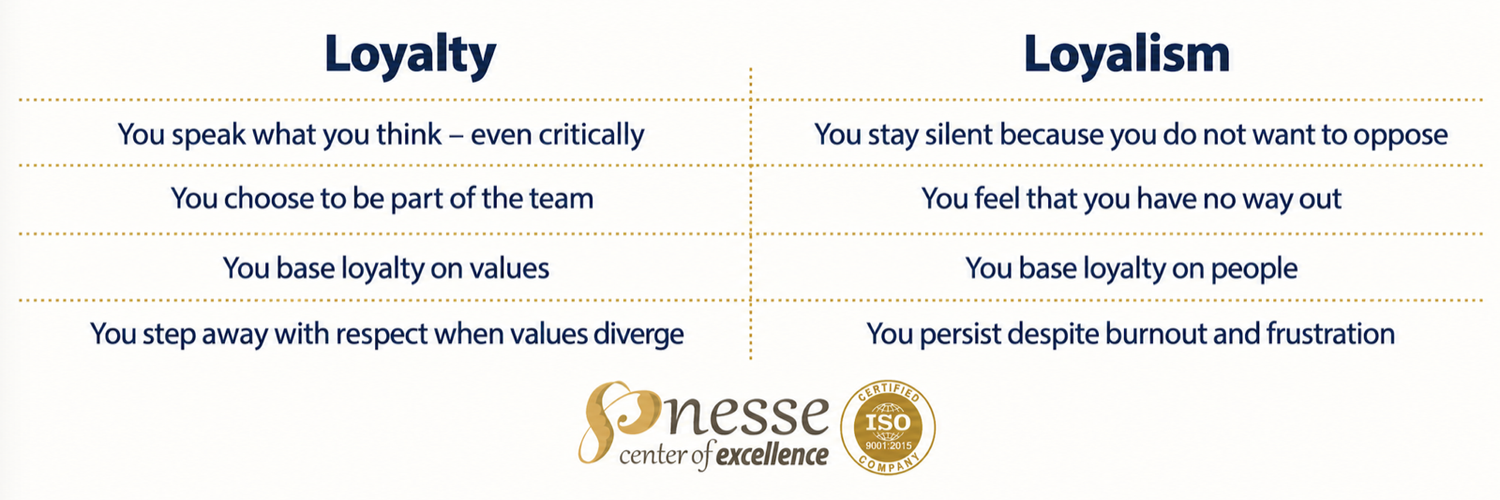
In a culture of loyalism, loyalty is judged, measured, commented on.
Who stays after hours, who never complains, who is “always available” – they are the ones who earn a reputation as “truly devoted”. The rest? Well – “difficult”, “not team players”, “with a problem”.
Examples of loyalty games at work:
Who arrives first, who leaves last
(An unwritten contest for the most “engaged”)
Informal culture spies
(People who tell the manager “who has been complaining about the team lately”)
Internal loyalty tests
(Situations like: “Let’s see who agrees without grumbling”)
The “us versus them” narrative
(E.g. “Our department is a family – the others aren’t as loyal as we are”)
All of this fuels a culture of fear, self-censorship and superficial agreement. Instead of a community, we have a theatre.
What does loyalism do to our minds?
Burnout and chronic fatigue (“I can never let anyone down”)
Reduced creativity (because disagreement = the risk of losing trust)
Polarisation and divisions in the team
Loss of trust in leaders (“does my contribution really count, or only my attitude?”)
How to build a culture of loyalty – without manipulation?
Instead of loyalty tests – invite shared responsibility
Trust is not blind faith – it is a willingness to hold a dialogue.
Instead of expectations – a contract
Loyalty should come from clear rules of cooperation, not from emotional pressure.
Instead of a “reward for loyalty” – recognition for added value
Appreciate contribution, not sacrifice.
Instead of “only the most faithful will survive” – room to leave with respect
Leaving the company doesn’t have to be betrayal – it can be an act of responsibility.
Loyalty is a beautiful thing – but only when it is a choice, not an expectation.
A culture of loyalism drives out authenticity and trust. A culture of shared responsibility builds a team that wants to stay because it sees meaning – not because “it’s the done thing”.
We don’t need loyalty games.
We need a culture that sees the person, not just their attitude.
