Have you ever met someone at work who seemed to be:
unmoved by other people’s emotions,
manipulating situations to their advantage,
constantly demanding attention and recognition?
If so, you have probably dealt with people showing traits of the so-called dark triad.
Privately, I have had a few such experiences, which is why I want to share with you what I have discovered about the dark triad in the work environment. I don’t need to convince you that it is a destructive combination of traits.

What is the DARK TRIAD and why is it worth knowing about?
When, in 2002, psychologists Delroy L. Paulhus and Kevin M. Williams first defined the concept of the “dark triad” in psychology, they opened the door to a new look at the darker sides of human personality. They hit the bullseye, because people had long struggled with the unconstructive behaviour of their fellow tribe members without knowing how to describe it collectively. The researchers found a common core for three key traits:
Narcissism,
Machiavellianism,
Psychopathy.
These traits differ from each other, but they share a common denominator: a lack of empathy and a tendency to manipulate. Since then, researchers around the world, including Tomas Chamorro-Premuzic, have begun to explore how these traits affect people’s lives – from work and hobbies to everyday interpersonal relationships.
The mysterious dark triad is present in everyday life, and its effects are particularly visible at work. It is a place where people interact intensely, cooperate and compete for resources, power and recognition. In such conditions, dark triad traits can easily surface, with destructive effects.
Research shows that people with dark triad traits often reach management positions thanks to their charisma, self-confidence and willingness to take risks. But the long-term effects of their presence can be highly destructive. Almost all of us have had, or have, someone around us who fits the dark triad profile and makes work feel like a grind.
Let’s get to know it better
The dark triad is a set of three personality traits – narcissism, Machiavellianism and psychopathy – which often occur together, creating a mixture that is exceptionally toxic for human relationships, especially at work. Each of these traits shows itself in different ways, depending on the person’s role: manager, colleague or client.
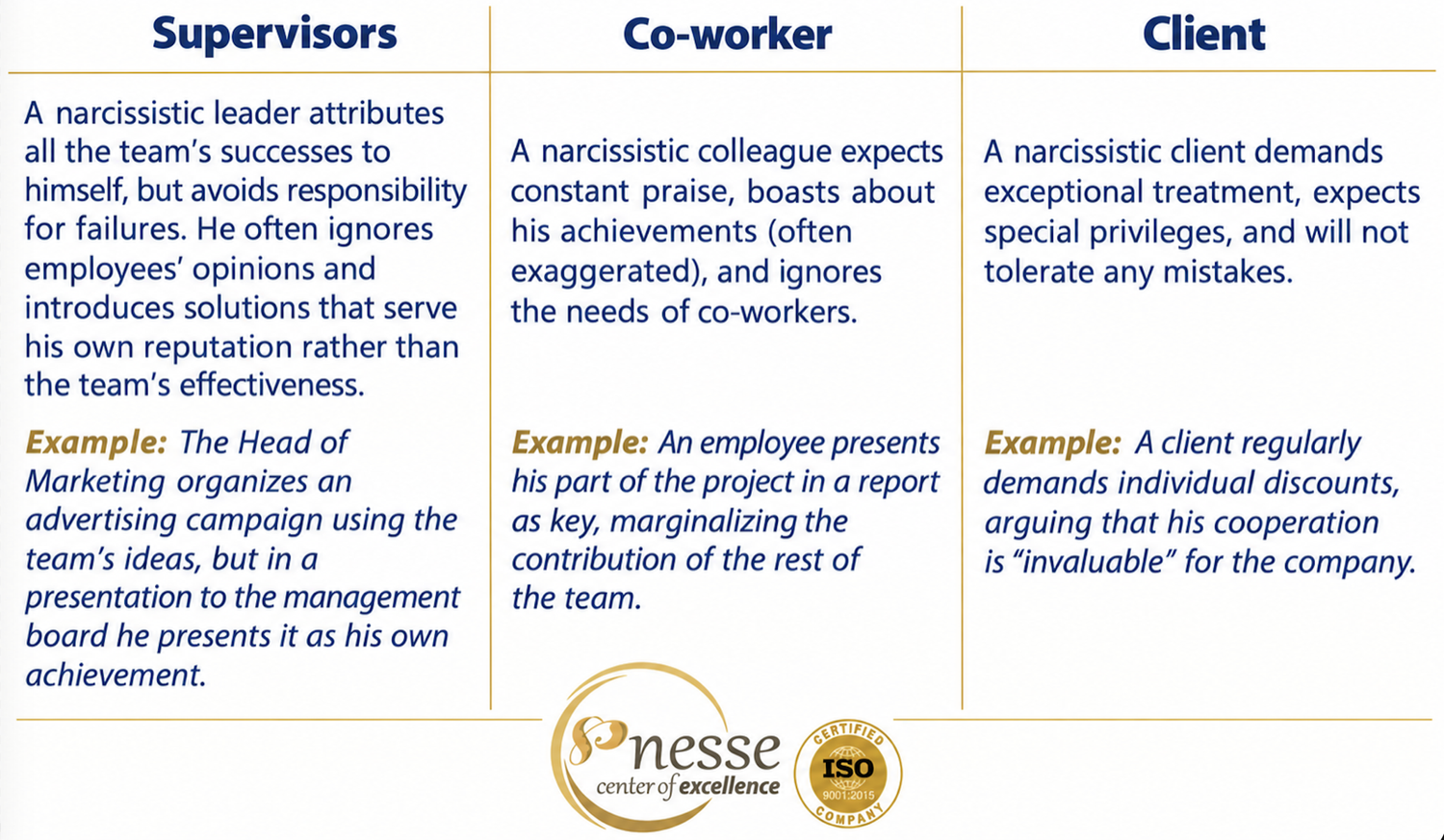
The narcissistic personality
Narcissistic people are characterised by an exaggerated sense of self-worth, a strong need for attention and recognition, and a disregard for the needs of others. At work, the narcissist focuses on their own successes and image, often at the team’s expense.
You know such characters from films: Miranda Priestly (The Devil Wears Prada), Jordan Belfort (The Wolf of Wall Street), Tony Stark (Iron Man). All of them have narcissistic traits. I have deliberately not named the actors who play these roles so as not to pin labels on them, but you can easily remember them or google them.
Signs of a narcissistic personality at work:
Constantly seeking attention and praise.
Taking credit for the team’s successes.
Avoiding responsibility for mistakes or failures.
Overreacting to criticism (e.g. anger, taking offence).
Focusing on personal gain rather than the common goal.
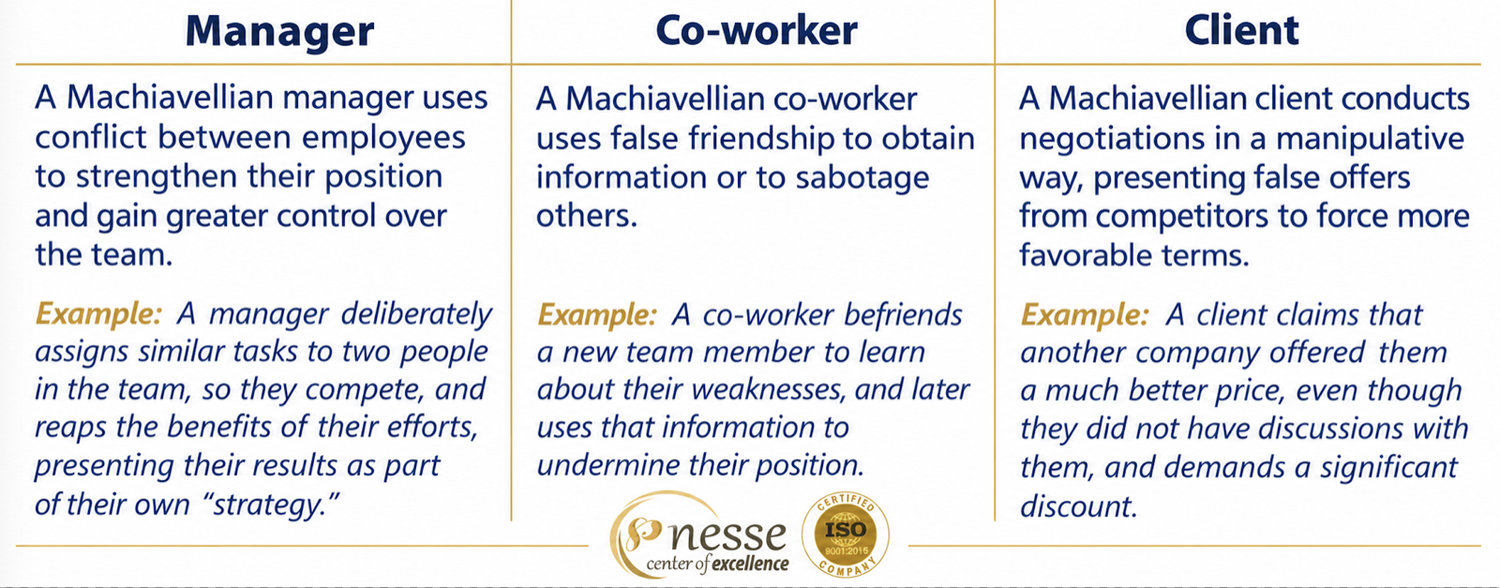
Machiavellianism
Machiavellianism is the ability to manipulate, cold calculation and pursuit of a goal at any cost. People with this trait are excellent at hiding their intentions, can build false alliances and manipulate others with ease.
Examples of film characters with Machiavellian traits: Frank Underwood (House of Cards), Scar (The Lion King), Tom Ripley (The Talented Mr Ripley), Tywin Lannister (Game of Thrones), Lord Voldemort (Harry Potter). Surprised that Niccolò Machiavelli isn’t among them? He only wrote “The Prince”, in which he described this style of exercising power and gave his name to this set of traits. Reportedly, he himself was not like that.
Signs of Machiavellian traits at work:
Frequently manipulating facts and information.
Building false alliances and feigning friendship.
A tendency to exploit other people’s weak points.
Undermining trust in the team by spreading gossip or conflict.
Pursuing goals regardless of morality or ethics.
Psychopathy
Psychopaths at work show a lack of empathy, impulsiveness and a tendency towards risky actions. They are often ruthless in pursuing their goals and feel no remorse for the harm they cause others.
Shall we look for famous characters on the silver screen again? Who hasn’t heard of Hannibal Lecter (The Silence of the Lambs), Patrick Bateman (American Psycho), Catherine Tramell (Basic Instinct) or Walter White (Breaking Bad)? And these are just modest examples.
Signs of psychopathic traits at work:
A lack of empathy for others’ feelings and needs.
Impulsive and risky decisions.
No fear of the consequences of one’s actions.
A tendency to intimidate others to achieve goals.
A cold and calculating approach to relationships.
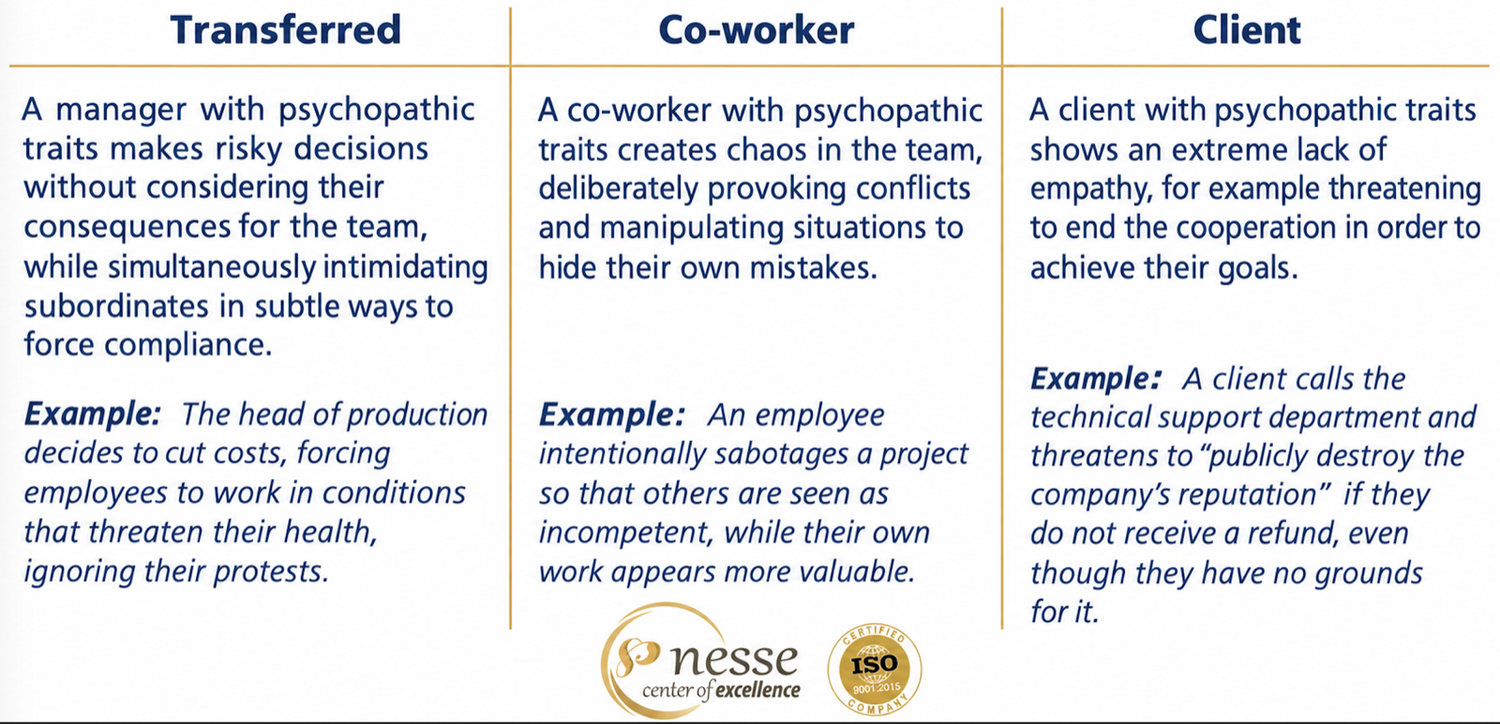
In each of these roles, the dark triad can destabilise the work environment, raise stress levels and lead to serious consequences for both individuals and whole teams. There are also combinations and hybrids of these traits: Machiavellianism with psychopathy, narcissism with psychopathy, and so on…
Let’s also remember that labelling someone a narcissist, psychopath or Machiavellian is a hurtful branding. Psychiatrists spend hours on diagnoses, using their knowledge, experience and years of study, before concluding something like that. Let’s not think we know better. Let’s rather talk about dark triad traits surfacing in the work environment. Let’s not stigmatise anyone with a hasty label.
Consequences for the organisation
The presence of people with dark triad traits at work has a destructive effect on organisational culture, business results and employees’ mental health. Their toxic behaviour lowers team morale, leads to high staff turnover and creates an atmosphere of fear and uncertainty. Although their actions can sometimes improve results in the short term, in the long run they destroy relationships and stability in the organisation. For employees, this means higher stress, more frequent conflicts and a greater risk of burnout. A thorough analysis of the consequences of the dark triad surfacing, however, needs a separate article.
How to cope?
This is another area I will only signal in this article and develop in later ones. There is so much of it.
What a leader can do: promote transparency and open communication; develop and introduce tools for collecting feedback from the team, such as 360-degree assessments; identify the first signs of toxic behaviour and phenomena and talk about them; monitor leaders’ actions so that they react quickly to first observations. It is also very important to promote and reward not only high results but also credibility and the high trust people place in a given person.
What employees can do: recognise toxic patterns of behaviour; avoid getting into and involved in conflicts; document other people’s problematic behaviour (one reason is a report to HR, the other is that perpetrators are often not aware of what they are doing); seek support from colleagues they trust; build their own trust.
Remember that:
The dark triad is a threat to workplaces – narcissistic, Machiavellian and psychopathic people can have a destructive impact on teams, organisational culture and employees’ mental health.
Recognition is key – understanding the signs of narcissistic, Machiavellian and psychopathic behaviour allows a faster response.
Leaders’ actions matter – building transparency and open communication and monitoring toxic patterns help limit their impact.
Employees have tools too – documenting toxic behaviour and seeking support in the team are effective steps in dealing with difficult situations.
Act consciously – understanding the dark triad is the first step to minimising its effects and building a healthier work environment.
Share your experiences or learn more about strategies for dealing with toxic personalities – I invite you to our training sessions and workshops, where we teach how to cope with such behaviour.