78.3% of Poles reported symptoms of burnout in 2024, according to research by UCE Research and e-psycholodzy.pl. In addition, as many as 41% of people quit their jobs because of toxic behaviour by their superiors (Business Insider Polska, 2022), and 41.4% of employees experience bullying at work (Infor, 2024). These figures are alarming and clearly show that the workplace is becoming an increasingly difficult place to function.
Behind many of these destructive phenomena are people with the traits of the so-called dark triad: narcissism, Machiavellianism and psychopathy. It is a set of personality traits which, although they sometimes contribute to short-term success, wreak havoc on teams and organisations in the long term. The narcissist constantly seeks recognition regardless of the cost; the Machiavellian manipulates their surroundings to achieve their goals; and the psychopath acts without scruples or empathy, often causing chaos and fear.
In this article we take a closer look at how the dark triad affects burnout – both as a major factor leading to burnout in others and in terms of how susceptible people with these traits are to burnout themselves. It is an important topic, because understanding how toxic personalities operate is the first step towards a healthier workplace.

Is every inappropriate behaviour bullying, and does it always lead to burnout? Is everything the dark triad’s fault?
Not every inappropriate behaviour is bullying, and not every such action leads to burnout. Likewise, not all problems in the workplace result from dark triad traits. Many factors influence the atmosphere in an organisation and employees’ wellbeing.
Not every inappropriate behaviour is bullying
Workplace bullying has a very precise definition: systematic, long-term and deliberate action aimed at humiliating, intimidating or eliminating an employee from the team. One-off incidents or interpersonal conflicts, although inappropriate, do not meet the criteria of bullying.
Not every inappropriate behaviour leads to burnout
Burnout results from chronic stress, but not every inappropriate behaviour at work has to lead to it. Much depends on individual psychological resilience, support from the team and managers, and the ability to cope with difficulties.
Is everything the dark triad’s fault?
Not all workplace problems result from the presence of people with dark triad traits. A toxic environment can be the result of many factors, such as:
Weak organisational management (e.g. no clear rules or policies).
An inappropriate leadership style (e.g. excessively authoritarian or chaotic).
Conflicts arising from personality differences that are not necessarily related to the dark triad.
Pressure from external conditions, such as economic crises or a heavy project load.
However, remember that an accumulation of these factors can create circumstances in which narcissistic or psychopathic traits and manipulation surface more easily. Understanding the dark triad helps you recognise destructive patterns and counter them effectively. It is also important to keep perspective: in many cases, problems at work can be solved through proper communication, mediation and education before they turn into more serious phenomena such as burnout or bullying.
The impact of the dark triad on burnout:
The narcissist boss
Narcissistic people at work focus mainly on themselves – their needs, achievements and recognition. For them, the team’s success is merely a tool for building their own image.
How does it contribute to burnout?
By being excessively demanding: Narcissistic leaders impose high standards and expect perfection regardless of the team’s capacity. Employees often work beyond their strength to meet these expectations, which leads to chronic stress.
By withholding recognition: The narcissist boss takes credit for all the team’s successes, showing no gratitude or appreciation for employees’ efforts. This lowers motivation and self-worth among team members.
By pressuring for perfection: Even minor mistakes can be met with harsh criticism or public humiliation, causing fear and a loss of psychological safety at work.
Example: The head of a sales department constantly demands unrealistic results while publicly criticising employees for every slip. Employees feel tired, undervalued and overwhelmed by pressure, which leads to burnout.
The Machiavellian kills the atmosphere
Machiavellian people masterfully manipulate their surroundings, using others to achieve their own goals. They act without scruples, and their tactics destabilise teams and lower morale.
How does it contribute to burnout?
Manipulates: Machiavellians deliberately set colleagues against each other to profit from the chaos. Employees who become victims of these manipulations feel betrayed and isolated.
Stirs up conflict: Creating an atmosphere of uncertainty and rivalry leads to stress and a sense of lacking support in the team.
Lowers morale: They constantly undermine others’ competence or take credit for their successes, which results in frustration and lower engagement.
Example: A team member wins a new employee’s trust only to later use their ideas as his own. As a result, the new employee loses faith in the team and experiences frustration, feeling undervalued and cheated.
The psychopath in the office
Psychopaths at work are characterised by a lack of empathy, impulsiveness and a tendency to intimidate. Their actions often create a sense of threat and chaos in the workplace.
How does it contribute to burnout?
Intimidates: Psychopathic leaders use verbal aggression, threats or cold manipulation to hold on to power. Employees feel constantly threatened and forced to submit. They are not afraid to resort to blackmail.
Lack of empathy: They ignore the team’s needs, such as work overload or personal problems, which leads to employees’ emotional exhaustion.
Making impulsive decisions: Their chaotic and risky actions destabilise teams and make work unpredictable, which causes stress.
Example: A manager introduces sudden changes to a project just before it is finished (with no clear need), ignoring the team’s protests. Employees have to work overtime to meet the new requirements, which leads to their physical and mental exhaustion.
In the work environment, the dark triad acts as a catalyst for burnout. The toxic behaviour of such people creates pressure, destabilisation and a lack of security, which in the long run destroys not only individuals but whole teams.
Does the dark triad burn out?
People with dark triad traits – narcissism, Machiavellianism and psychopathy – often seem resistant to difficulties at work. Their lack of empathy, high self-esteem and skill at manipulation allow them to avoid responsibility and cope with pressure effectively. But this resilience has its limits, and living in chronic stress – from the need to maintain a false image and control their surroundings – can lead to their burnout too.
The susceptibility to burnout of a person showing dark triad traits is an individual matter that depends on the intensity of those traits. Nobody is simply 0 or 1, so there are people with a weaker tendency and people with a stronger one.
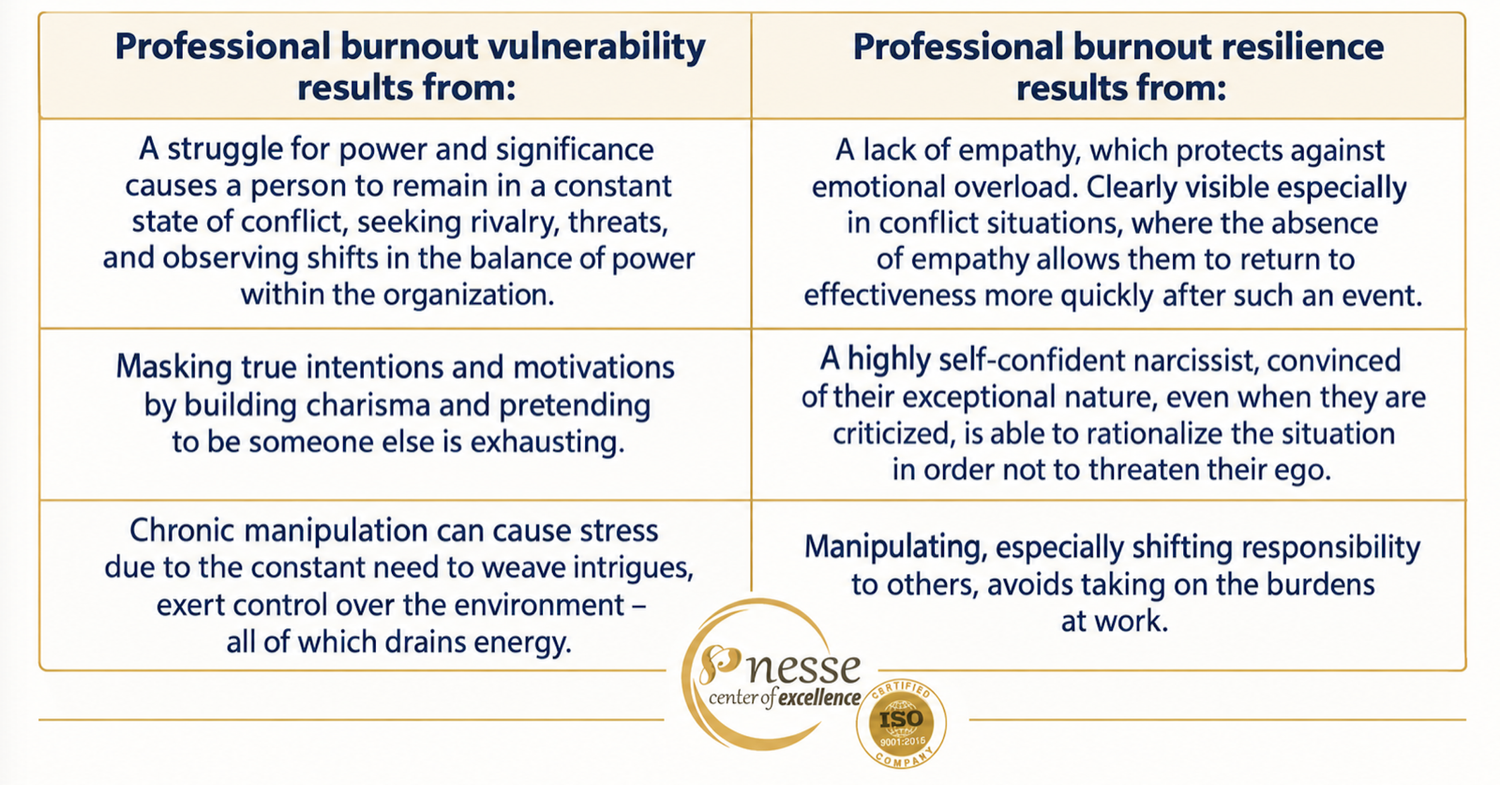
The double face of resilience and vulnerability
People with dark triad traits may seem resistant to stress and burnout thanks to their cool approach to relationships and work situations. Yet their life in constant tension, resulting from the need to control their surroundings and protect their image, exposes them to burnout on another level – not emotional, but strategic and psychological.
The key question is how long they can function in this mode before exhaustion starts to affect their ability to act effectively.
Ten rules for dealing with the dark triad without burning out
1. Recognise toxic behaviour
The first step is to understand who you are dealing with. Watch carefully whether someone around you shows characteristic behaviours such as manipulation, a lack of empathy, a need to dominate or a tendency to stir up conflict. Recognising toxic patterns helps you prepare to act.
2. Set clear boundaries
People with dark triad traits often test others’ boundaries. It is important to define clearly which behaviours are acceptable to you and which are not. Learn to communicate your needs assertively and defend your position.
3. Document incidents
If you experience manipulation, bullying or other inappropriate behaviour, keep notes recording the dates, times and details of incidents. Documentation can be crucial if you decide to report the matter to your managers or HR.
4. Don’t engage in psychological games
Machiavellian and psychopathic people often provoke conflicts to create chaos or divert attention from their actions. Try not to get drawn into their manipulations and stay calm in stressful situations.
5. Look for support
Don’t fight a toxic environment on your own. Talk to colleagues you trust, a mentor or HR. Acting together can help counter toxic behaviour more effectively.
6. Look after your work-life balance
One of the key ways to avoid burnout is to maintain a healthy balance. Make time for hobbies, rest and seeing your loved ones to recharge your batteries and keep your distance from what is happening at work.
7. Build your psychological resilience
Mindfulness techniques, meditation or cognitive-behavioural therapy can help you cope with pressure and negative emotions. Learn to identify and control your reactions in difficult situations.
8. Use company policy
Familiarise yourself with your organisation’s rules and policies on bullying and inappropriate behaviour. If you notice toxic people breaking the rules, report the problem to the appropriate people, such as your managers or HR.
9. Focus on your goals
Toxic people often draw attention away from priorities by pulling others into their games. Focusing on your tasks and clearly defined goals will help you stay productive and avoid excessive stress.
10. If necessary, seek external help
If the situation at work starts to affect your mental or physical health, don’t hesitate to seek help from a specialist such as a psychologist or therapist. External support can be crucial in regaining balance and finding strategies for coping with a toxic environment.