Over recent months we have analysed various values that influence a person’s level of motivation. We looked closely at 16 values according to Prof. Steven Reiss’s approach. We considered the values that make up Edgar Schein’s Career Anchors. We also mentioned Shalom Schwartz’s circle of values. Today it is time to give Schwartz a little more attention.

This approach is not particularly well known or popular in Poland, which is a pity. Its universality and comprehensiveness make it worth using in development programmes.
Shalom Schwartz is an Israeli social psychologist and a researcher of cultures and cross-cultural approaches, but above all the author of the Theory of Basic Human Values. Together with the theory, he built a scale for measuring values. The theory develops the cross-cultural approach begun by Hofstede.
Schwartz initially identified 10 basic human values, each distinguished by its goals and motivations. He developed his approach over the years, and in 2012 he expanded the list by another 9 values.
He gave these values a graphic form as a circle, which also has symbolic meaning. Values located next to each other on the circle (a mechanism similar to the colour wheel) complement each other, whereas values located opposite each other are in conflict.
In the expanded version after 2012, he placed the individual values in rings that act as a kind of classification.
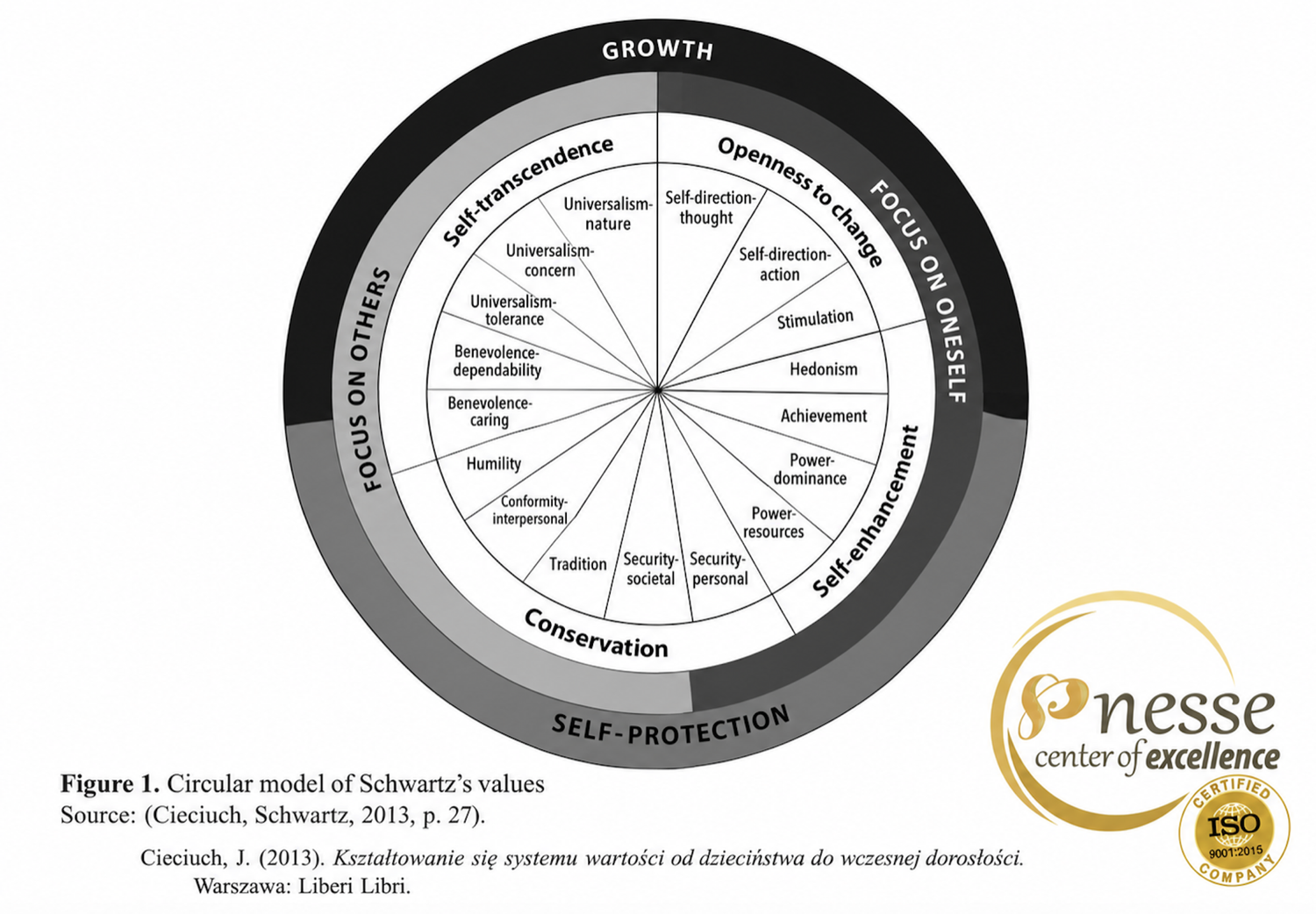
The widest ring divides values into those concerning:
Growth – seeking the new, self-improvement, exploration and embracing change.
Self-protection – striving to maintain the status quo, security and tradition.
The inner ring of the classification is divided into:
A personal focus
A social focus
Which corresponds to the direction of attention.
Deeper in the circle we find the groups of values relating to:
Openness to change
Self-transcendence
Conservation
Self-enhancement
These rings not only organise the list of values but also help us understand how they relate to each other.
In the conservation group we have the following values:
1. Face – face lies partly in conservation and partly in self-enhancement.
2. Societal security – is nothing other than a love of harmony, an absence of conflict, building good relationships with others and cooperation.
3. Personal security – in this sense it is the need to look after one’s own psychological space and build self-worth.
4. Tradition – respecting rules and systems; being deeply anchored mentally in one culture, which may make it hard to accept other cultural approaches. Tradition as a value also means striving for consistency and permanence and celebrating important moments.
5. Conformity to rules – understood as conformity with procedures, principles and rules. It means a low propensity for change and rebellion.
6. Interpersonal conformity – conformity in this sense means striving to listen to others, attachment to and a wish to be part of a group, and restraining one’s own impulses and aggressive behaviour that could hurt someone. It means not only obedience but also self-discipline and loyalty.
7. Humility – humility lies partly in conservation and partly in self-transcendence. In the context of “conservation” it means modesty and not standing out from the crowd – a tendency towards egalitarianism.
In the self-transcendence group we have:
7. Humility – mentioned earlier, but in the context of “self-transcendence” it means striving for self-improvement, straightforwardness and sincerity. It is close to asceticism.
8. Benevolence as caring – is the pursuit of good cooperation with others and a wish to maintain wellbeing and frequent personal contact with others.
9. Benevolence as dependability – refers to supporting and helping others, sometimes subservience, doing things for others and sacrificing oneself for them.
10. Universalism as concern – is nothing other than recognition: a need for respect for other people and acceptance of difference.
11. Universalism as nature – covers respect for nature and the need to protect it.
12. Universalism as tolerance – the need to accept and not judge difference.
In the openness-to-change group we have:
13. Self-direction in thought – means a tendency to choose, create, discover and be creative.
14. Self-direction in action – means free will in taking action independently of others, as well as self-respect and privacy.
15. Stimulation – values excitement, novelty, challenges and variety; such people like things to be happening, and their adaptability to change is usually higher.
16. Hedonism – which belongs partly to openness to change and partly to self-enhancement. In terms of openness to change, it means curiosity about the new, seeking new sources of pleasure and experimenting.
In the self-enhancement group we have:
16. Hedonism – mentioned earlier. In terms of self-enhancement, it means enjoying life and what is, a tendency to squeeze every bit of joy out of what is, and self-indulgence.
17. Achievement – is nothing other than the pursuit of personal success, demonstrating competence, acting and competing, but in line with social standards. After all, an achievement will be visible and accepted if it is noticed and approved by others.
18. Power over people – is nothing other than the power to rule over others, to control and dominate them; it is close to face and achievement.
19. Power over resources – is also a striving for control and dominance, but the key here is control of resources. This value is linked to a desire to get rich, gain influence and monopolise.
1. Face also mentioned earlier, as it also belongs to conservation – in this sense it is the pursuit of importance and recognition, gaining the attention of others and climbing the social ladder.
The practical lessons of exploring Schwartz’s circle:
Transferring and adapting such approaches and theories into practice always brings some challenges. What matters, however, is understanding how awareness of our own and others’ values, and an understanding of their nature, affects our everyday language and everyday expectations of others.
For example, as managers we want someone who will at the same time 1) be creative and proactive, seeking and implementing innovations, and 2) be able to work within corporate structures. These two expectations may be mutually exclusive. The first requirement belongs to the values of “stimulation” and “self-direction in action”. The second stems from the value of “conformity to rules”. They lie on opposite sides of the circle, and it is hard to find a person who is guided by both values to the same degree. These values are in conflict. Even if we find a person who represents both values with similar intensity, which is extremely rare, they may be so internally conflicted and emotionally unstable that their actual effectiveness will be low.
To fully understand how the values we hold affect our emotions and choices, it is also worth reflecting on their meaning. We need to go a little beyond the popular definition that values are what matters most to us in life.
Each of us holds many values (e.g. achievement, security, benevolence) of varying importance. A particular value may be very important to one person but unimportant to another.
When we talk about values, we make the following assumptions about them:
Values are beliefs inextricably linked to emotions. When values are satisfied, people are in a state of emotional balance. When a value is threatened, a strong emotion arises, and people take action (motivate themselves) to satisfy that value and return to balance. When activated, values become infused with feeling. People for whom independence is an important value become aroused when their independence is threatened, despair when they cannot protect it, and are happy when they can enjoy it.
Values refer to desirable goals that motivate action. They set goals and a vision of how to fulfil them.
Values transcend specific actions and situations; they are broader and deeper than organisational values. This feature distinguishes values from norms and attitudes, which usually refer to specific actions, objects or situations.
Values serve as standards or criteria. Values guide the choice or evaluation of actions, policies, people and events. People decide what is good or bad, justified or unjustified, worth doing or avoiding, on the basis of the possible consequences for the values they hold dear. But the influence of values on everyday decisions is rarely conscious. Values enter awareness when the actions or judgements being considered have conflicting implications for different values we cherish.
Values are ordered by their importance relative to each other. People’s values form an ordered system of priorities that characterises them as individuals. Do they attach more importance to achievement or to justice, to novelty or to tradition? This hierarchical feature also distinguishes values from norms and attitudes.
The relative importance of multiple values guides action. Any attitude or behaviour usually has implications for more than one value. For example, going to church may express and promote the values of tradition and conformity at the expense of hedonism and stimulation values. Values influence action when they are relevant in the context (and therefore likely to be activated) and important to the actor.
In summary – why do I need this knowledge and how will I use it?
Greater awareness of and sensitivity in defining our own expectations
Greater awareness of and sensitivity to the otherness of other people
We spare ourselves the disappointment of not being able to find the ideal person for the job.
We better understand our employees’ choices and decisions, and we can also anticipate and assess possible risks.
We will manage change more effectively from an emotional perspective.
We will build teams more effectively, especially strategic teams that are to work together for a long time.
Finally, we will not create confusion in communication by relying on our everyday (i.e. our own) understanding of words describing values and priorities.