There is a department in your company whose name alone makes you clench your teeth. They block batches, grumble, delay and bounce your orders back. You have the impression they do it on purpose – to undermine your plan.
I have some uncomfortable news for you: they think exactly the same about you.
And that’s the first key to the whole situation. Because as long as you see malicious people on the other side who have it in for you, you’ll be fighting a war that can’t be won – because there is no enemy in it, just two managers held accountable for things that are mutually exclusive.
This text isn’t about how to fix the system (you can’t do that from your chair). It’s about how to stop losing every interface within that system.
They aren’t playing against you. They’re playing for their own goal.
Quality blocks your batch not because they don’t like you, but because they are held accountable for defects. Sales promised an impossible deadline because they are held accountable for signed orders. Maintenance is dragging its feet because it is juggling five breakdowns at once and yours is fourth in the queue.
Each of them is doing exactly what they get a bonus for. And that’s exactly why they get in your way.
This isn’t a call to be nice to everyone. It’s a tactic. You can’t influence someone whose motivation you don’t understand. If you know what the person on the other side is held accountable for, you have a lever in your hand. If you don’t, you’re shooting blind and wondering why you keep missing.
Three moves that only make things worse
Before we get to what works – three reflexes that feel like fighting your corner but actually dig you in deeper.
Escalating straight away. You run to the director with every dispute. In the short term it sometimes works. In the long term you hurt yourself twice: you get branded as a manager who can’t get along horizontally, and the department next door remembers that you went and complained. The next interface will be harder, not easier.
The “who’s to blame” game. Proving it’s their fault gives you five minutes of satisfaction. You pay for it with the relationship and the next handover. You won the argument and lost the cooperation.
Demands without a relationship. You only show up when you need something – and you need it yesterday. Someone who knows you solely as a source of problems won’t go out of their way for you.
Tactics at the interface – what really works?
Here’s the practical part. Five moves you can make on your own, without changing the system and without authority over the neighbouring department.
1. Speak the language of their goal, not yours. Stop asking for help in delivering your plan – they don’t care about it, they have their own. Translate your need into their indicator. Don’t say to quality “I need to release this batch”, say “if it stops and goes out late by force, it’ll come back as a complaint – and complaints are your result”. Don’t say to maintenance “fix my machine”, say “this downtime is about to hit the availability you’re measured on”. Suddenly your problem becomes their problem – and suddenly they’re on your side.
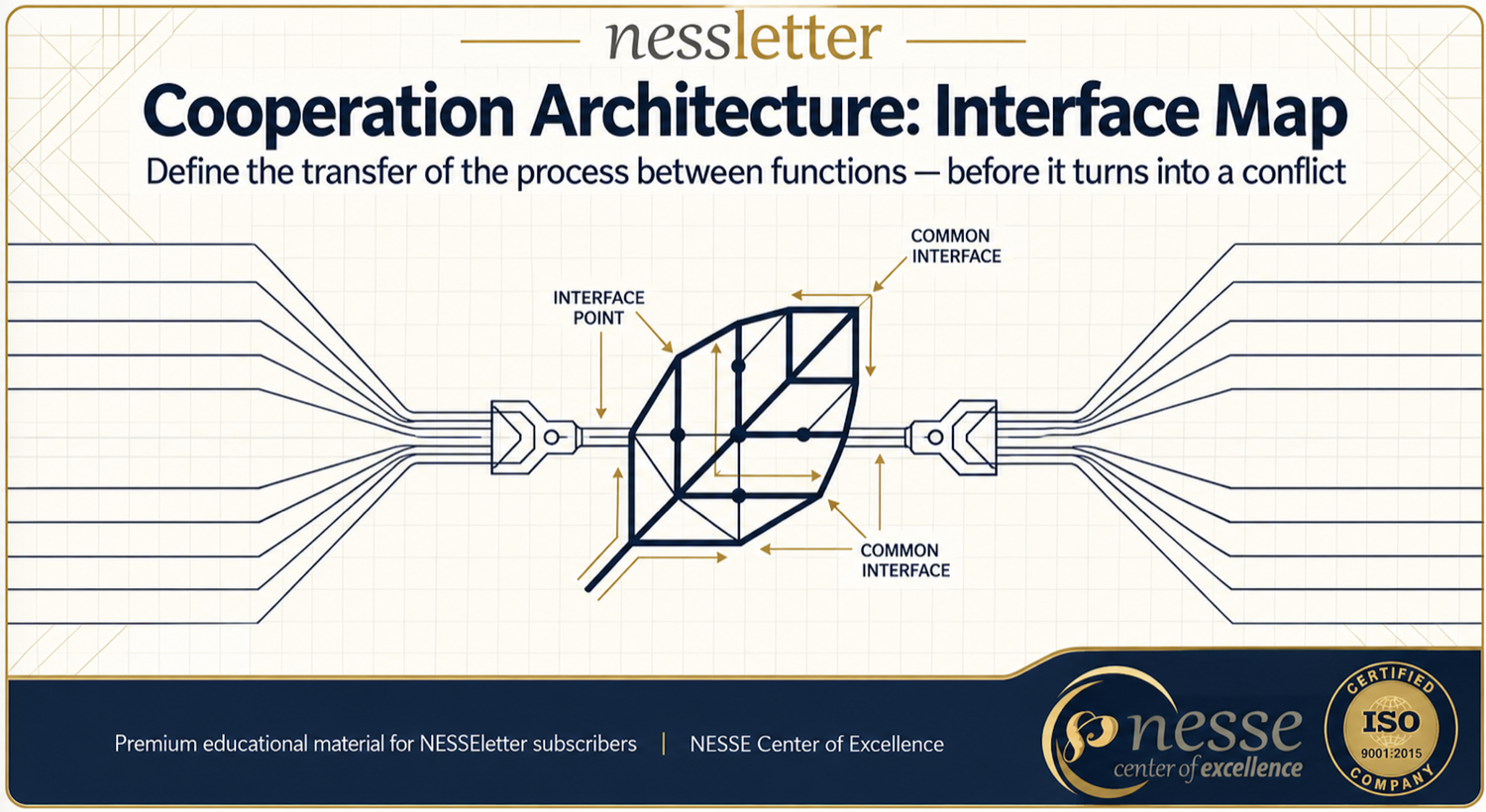
2. Agree the interface before a dispute breaks out. Most conflicts arise where nobody agreed beforehand who is responsible for what at the boundary. Don’t wait for the board to impose rules. Call your counterpart in the neighbouring department before the project or season and agree as equals: who hands over what, to whom, in what condition and by when. Half an hour of conversation at the start saves weeks of escalation later.
3. Build credit before you need it. Interdepartmental cooperation works like a bank account. If you only make withdrawals – demanding, pushing, escalating – you quickly go into the red. Make deposits in advance: help them when they’re up against the wall, show up sometimes without a demand, get to know the people on the other side by name. On the day you really need a favour, you’ll find you have something to draw on.
4. Resolve things horizontally; escalate the problem, not the person. Before you go higher, try to solve it at your level – directly with your counterpart. Escalate only when that level really fails. And when you have to – escalate the shared cost, not someone’s fault. “We have a problem at the interface that is costing the company X, and we need a decision” opens doors. “It’s their fault, put pressure on them” closes them for the future.
5. Read style, not malice. Very often, what you take for hostility is simply a different working style. Someone is fast and direct – you take it as aggression. Someone is cautious and meticulous – you read it as blocking and nitpicking. When you learn to recognise that the other manager isn’t malicious but simply thinks and communicates differently, half the clashes that came from pure misunderstanding disappear. It’s the difference between “they’re impossible to deal with” and “I know how to talk to them”.
What you can’t change on your own – and what to do about it?
Let’s be honest: part of this conflict is beyond you. If your department and the one next door have conflicting goals built into your bonuses, no communication tactic will fully defuse it. That’s a problem of the incentive system, and the system is changed one floor up – in HR and on the board.
And that’s your move too – just a different one. Where the friction keeps coming back despite your efforts, don’t bang your head against the wall forever. Gather data: how many times a month this interface generates a dispute, how much time and money it costs. And take it higher not as a complaint about people, but as a measurable cost to be solved. A manager who comes with a number and a proposal, not with a grievance, is listened to differently.
Your tactics deal with the symptoms day to day. Fixing the source is an organisational decision. Both are needed – and both are within your reach, each in its own way.
First, stop losing at the interfaces.
You won’t fix the whole system from your chair. But you can stop being the manager who loses every handover, escalates every dispute and fights the same war with the same department every week.
The difference isn’t that you’ll start winning arguments. It’s that you’ll stop having them – because you’ll learn to talk to people on the other side in their language, set up the interface before it breaks, and tell a different style from bad will.
And then the department that was “playing against you” turns out to be simply another team playing for its own goal. Just like you.
For managers who want to have this at hand, we have prepared an “Interface Card” – a short list of questions and steps that set up cooperation with a neighbouring department before it turns into a dispute (in Polish). And if you feel the same war comes back every month, it’s a sign it’s worth developing specific competencies: negotiating at departmental interfaces and reading cooperation styles. At NESSE we develop exactly that with managers and plant managers in manufacturing and logistics.