

In articles, books and reports we often hear the phrase “Western civilisation”. We assume that it is our civilisation, our world. Unfortunately, this way of thinking makes us subordinate others to our own view of the world. We are disappointed when things are different. A high awareness of intercultural differences starts precisely with knowledge about different cultures.
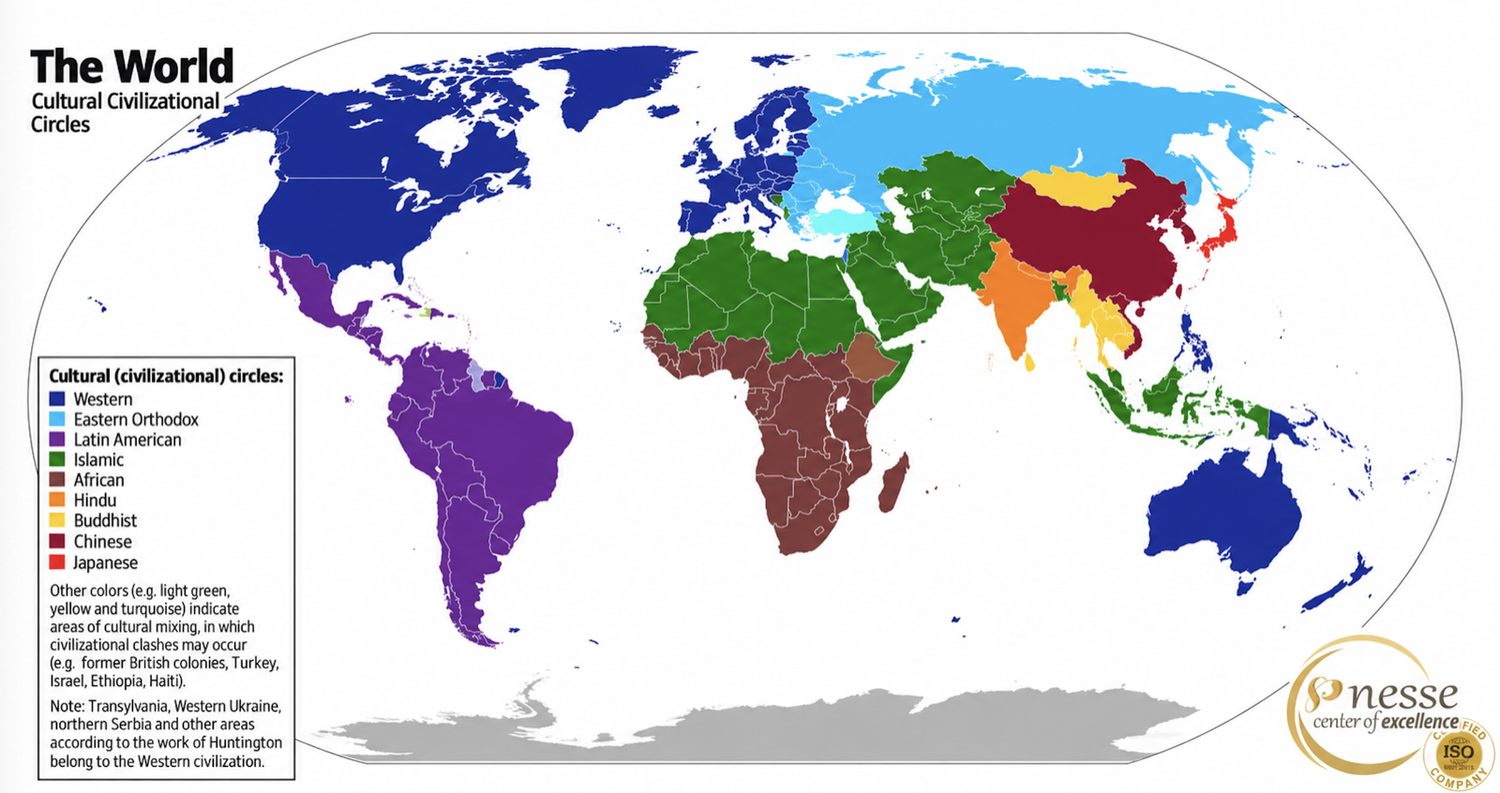
Samuel Phillips Huntington, an American political scientist and scholar, is best known for his theory of cultural and civilisational circles. His book “The Clash of Civilizations” started a debate on how cultural differences influence international relations. In the context of work, the differences between civilisational circles have a significant impact on people’s approach to work. In this article we look at what divides and what unites people from different civilisational circles in a professional context.
African civilisation:
African civilisation includes many diverse ethnic groups and cultures. At work, features such as a strong sense of community, flexibility with time and adaptability are visible. In some African communities, greater emphasis is placed on human relationships than on material results.
Buddhist civilisation:
Buddhist countries such as Tibet, Mongolia, Sri Lanka and Thailand place great emphasis on balance and harmony. Employees from these regions often show calm, patience and focus. Many Buddhist communities also value spiritual development and self-improvement.
Chinese civilisation:
Chinese civilisation, covering China, Korea, Vietnam, Taiwan and Singapore, is characterised by strong traditions, social hierarchy and respect for elders and authority. Chinese employees are often persistent, hard-working and determined, attaching great importance to results and achievements.
Hindu civilisation:
Hinduism, dominant in India and Nepal, influences the approach to work in these regions. Hindu employees often strive for balance between professional and spiritual duties. Worshipping the gods through religious practice is also important.
Islamic civilisation:
Islamic civilisation, stretching from the Arab countries to Indonesia and Malaysia, is characterised by a strong sense of community and loyalty to the group. Muslim employees often show dedication, discipline and respect for hierarchy. Prayer and religious practice also play an important role in their working lives.
Latin American civilisation:
Latin American civilisation, covering the countries of Latin America, is known for its spontaneity, joy of life and close family ties. Employees from these regions often put emphasis on human relationships and a good atmosphere at work.
Japanese civilisation:
Japanese civilisation is known for principles such as precision, discipline and respect for hierarchy. In Japanese society, the pursuit of excellence and mutual understanding is important. Japanese employees are often dedicated, hard-working and disciplined.
Orthodox civilisation:
Orthodox civilisation, including Russia, Ukraine, Romania and Greece, among others, is characterised by a strong connection with tradition and religion. At work, Orthodox employees often show loyalty, discipline and respect for hierarchy.
Western civilisation:
Western civilisation, covering Western Europe, North America and Australia, places great emphasis on individualism, innovation and efficiency. Employees from these regions are often entrepreneurial, results-oriented and strive for professional success.
Within each of these civilisations there are, of course, differences in the approach to work, resulting both from the cultural context and from employees’ individual characteristics. It is important to understand and respect these differences in order to cooperate effectively in an international professional environment. Building mutual understanding, respect and cultural flexibility is the key to success when working with diverse civilisations and cultural circles.