
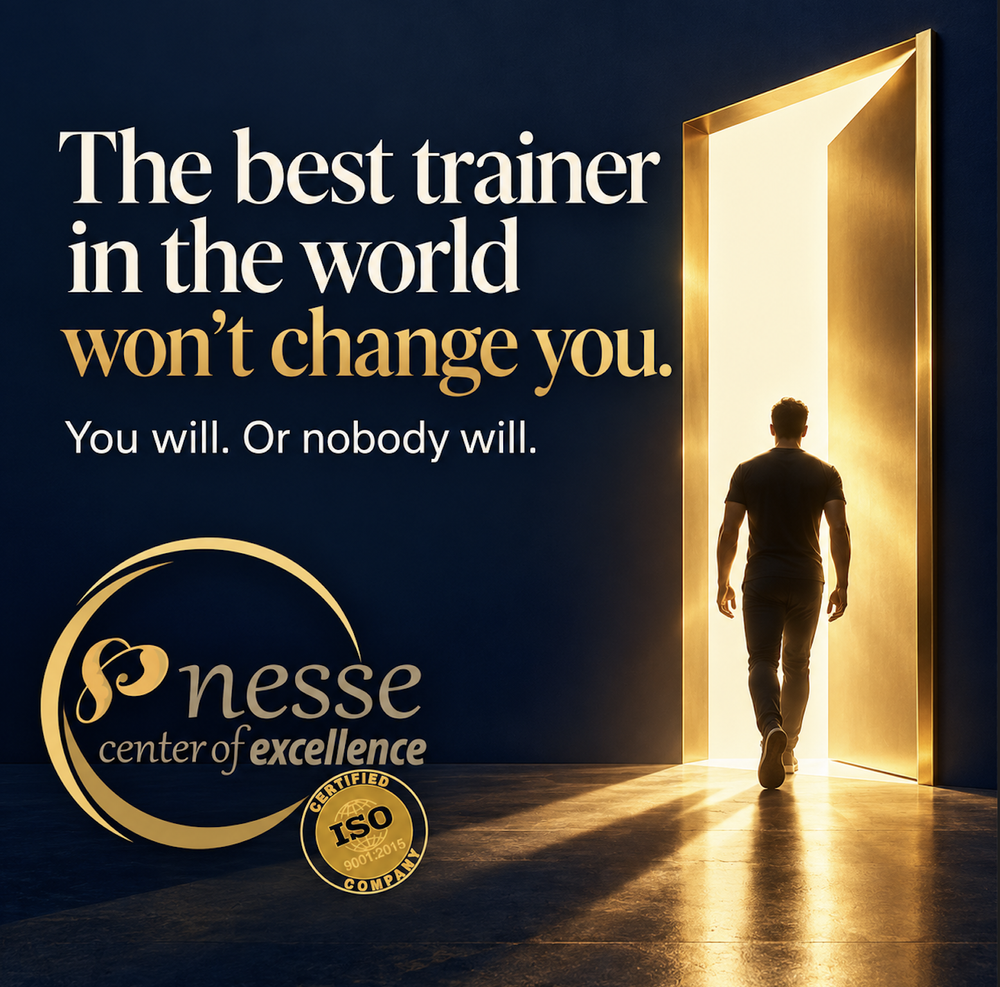
Are you at a training, or just “attending” it?
Many of us fall into the trap of thinking that training is a kind of “software update” – that it is enough to sit there for eight hours and the new knowledge will install itself in your head. The truth is more demanding: training is not surgery after which you wake up with new skills. It is more like going to the gym together. The trainer shows you how to lift weights without hurting yourself and how to build muscle fastest, but you are the one who has to feel the weight on your own shoulders.
The “reviewer” trap
After workshops we often focus on reviewing: “The trainer was fine”, “The catering was tasty”, “The examples could have been more industry-specific”. These are important elements of comfort, but they have nothing to do with your development. They are the ratings of a cinema audience.
The real work begins when, as a participant, you stop rating the show and start filtering every sentence the trainer says through the lens of your desk, your team and your difficult clients.
The viewer asks: “Was it interesting?”
The player asks: “How will I use this tomorrow so that at 4 pm I have less on my plate?”
You hold the “keys to the city”
If you approach a training assuming that “it won’t work here”, you will be right. Your brain will find a thousand pieces of evidence that the system is bad, the industry is specific and the clients are different from those in the textbook. That way you protect your comfort zone, but at the same time you block your own path to any improvement in results.
If, however, you decide “I’ll test this one element, if only to prove it doesn’t work”, you are also right. You switch into testing mode. And that is the moment your company’s training budget turns into your personal market asset. The knowledge you have has no market value. Only knowledge you can apply in practice has value.
Your role in this arrangement
At NESSE we believe in partnership. We provide systems, best practice and support, but you are the owner of your competencies. Your company can buy you time to learn, but it cannot buy you the curiosity and courage to change even one habit.
The biggest harm you can do to yourself is to leave a training feeling that you “know more”. Knowing more is not enough. Leave with the feeling that from tomorrow you will do one thing differently. Even if it feels artificial at first, even if it doesn’t go perfectly. It is the only way to go from participant to beneficiary.
Today’s task:
Think of the last technique or tool you heard about at a training in recent months. Don’t judge it. Just try to use it in your next difficult situation. You will see that you, not the trainer, have the last word in this game.