
Extended DISC
Practical data on how people really work
Extended DISC is a tool that shows how we differ in the way we act, communicate and respond to stress. With it, teams learn to use these differences as a strength – instead of a source of tension. It is not a test – it is a way to build conscious cooperation and develop leaders.

Why work with Extended DISC?
Better decisions – based on data, not intuition
Extended DISC provides concrete information about behavioural styles. Leaders and HR make development, recruitment and communication decisions based on facts, not hunches.
Less tension, more understanding
Teams learn to recognise differences in working and communication styles. This helps avoid conflicts caused by misunderstandings and build more equal relationships.
More effective leadership
The assessment shows which leadership behaviours support a manager’s natural style and which require conscious adaptation. Managers act with greater authenticity and confidence.
Development based on practice, not tests
Extended DISC at NESSE is not a report for the drawer. Every assessment ends with a feedback session and a plan for applying the results in the team’s daily work.

How we work with Extended DISC at NESSE
We assess
The assessment is done online, but interpretation always involves a person. We analyse the difference between natural and adapted behaviour – because that is what shows where the real potential and tensions lie.
We give feedback
Every participant has an individual feedback session with a NESSE trainer. It is not a walk-through of the report, but a conversation that turns data into concrete actions at work.
We link it to team development
Extended DISC doesn’t end with a report. We use the results in workshops on communication, leadership and team building – so theory immediately becomes practice.
We support implementation
We help leaders and HR translate the results into recruitment decisions, development planning and management conversations. Because a tool only makes sense when it really works in the organisation.
Extended DISC at NESSE is a process, not a test.
We don’t stop at the assessment. We translate the results into decisions, conversations and teams’ daily actions – so that behavioural style analysis genuinely supports people at work instead of ending up as a report in a drawer.
Who is Extended DISC for?
- For leaders – who want to better understand their own style of management, communication and influence on the team.
- For teams – that need to improve cooperation, communication and mutual understanding.
- For HR departments – looking for a tool to assess working styles, match roles and design development.
- For organisations in change – that want to manage people’s reactions to new standards and processes consciously.
- For companies developing a culture of feedback and cooperation – so that different styles support effectiveness instead of dividing people.
Extended DISC – one tool, many perspectives
HR gets:
- Reliable data on behavioural styles – instead of intuition in assessing fit and potential.
- A tool that links assessment with practice – easy to include in recruitment, appraisal and development processes.
- Insight into team dynamics – who complements whom, where the friction is, which styles dominate.
- Consistency with other NESSE tools – e.g. the Competency Map, the Reiss Motivation Profile, CCQ, Gallup or NEO-FFI.
- Arguments for conversations with managers – based on data, not opinions.
Teams and managers gain:
- A better understanding of differences in working and communication styles – which genuinely reduces conflict.
- Awareness of how their behaviour is perceived by others – and how they can adjust it.
- A common language for talking about cooperation, tensions and expectations.
- Greater effectiveness in delegating, motivating and holding development conversations.
- A development tool that doesn’t end with a report, but with real change in how people act.
Using Extended DISC in the organisation
Recruitment and role fit
Lets you check whether a candidate’s working style matches the requirements of the position and the team culture. Supports decisions based on data, not intuition.
Building and integrating teams
Makes it easier to work on understanding differences, communication and cooperation. Shows how to use the strengths of individual styles so that the team works in a complementary way.
Planning development and career paths
Shows in which environment and tasks a person can develop their potential – and what they are better off avoiding.
Leadership development
Helps managers understand their own leadership style, its impact on others and the areas that require conscious adaptation.
Resolving conflicts and tensions
Provides a language for talking about behaviours rather than emotions. Helps identify the sources of friction and turn them into concrete communication strategies.
What is Extended DISC?
Extended DISC is a diagnostic tool that describes a person’s behavioural style at work – the way they communicate, make decisions, respond to stress and build relationships. The model draws on the theory of Carl Gustav Jung and was developed by William Moulton Marston, who described four basic styles of action: D – Dominance, I – Influence, S – Steadiness, C – Compliance.
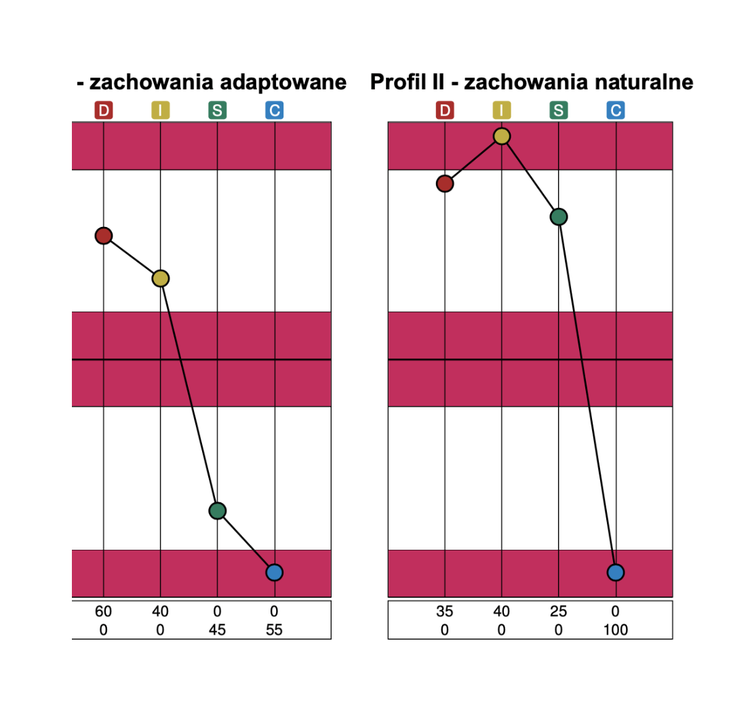
Unlike classic DISC tools, Extended DISC measures two profiles:
- Natural behaviour – how we act spontaneously, without pressure from our surroundings.
- Adapted behaviour – how we adjust to the demands of the work environment.
Comparing these profiles (as in the chart) shows where an employee’s energy flows naturally and where it costs effort – which makes it possible to diagnose sources of stress, motivation and development potential accurately.
Each of the four areas (D, I, S, C) describes a different way of acting, reacting and making decisions.
- D – Dominance (Intuition + Thinking) – results-oriented, competitive people of action. They make decisions quickly and like challenges, independence and authority.
- I – Influence (Intuition + Feeling) – enthusiastic, relationship-oriented types. They draw energy from contact with people, are creative, inspire others and motivate the team.
- S – Steadiness (Perception + Feeling) – calm, supportive, cooperative people. They value stability, predictability and good relationships.
- C – Compliance (Perception + Thinking) – analysts and perfectionists. They need rules, structure and high quality.
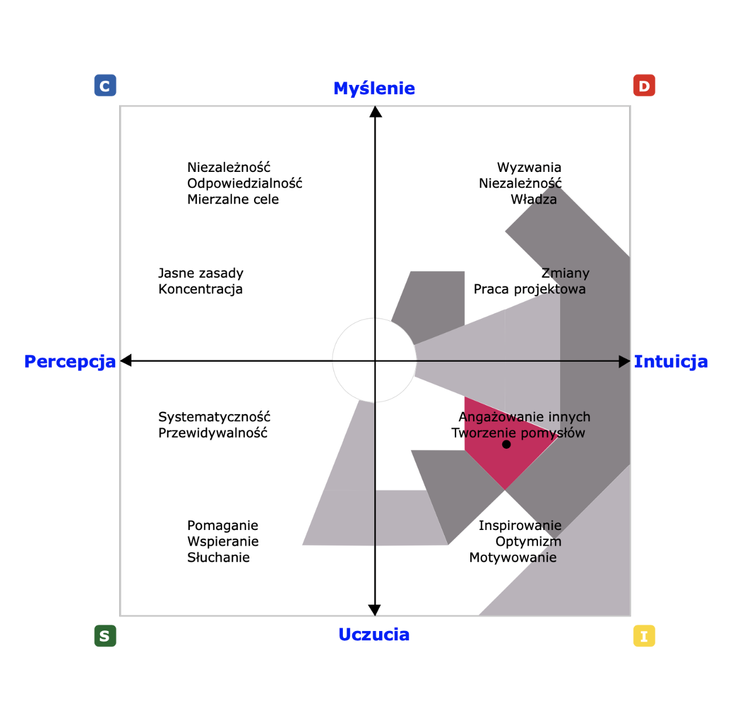
Everyone has all four styles, but in different intensities. The position marked on the map (the darker area) shows the individual behavioural profile – which traits dominate and which are less visible in daily work.
Extended DISC differs from other DISC-type tools in that it:
- is regularly validated on large international samples and culturally adapted for Poland,
- examines the dynamics of behaviour over time, not just a static “personality type”,
- combines psychometric precision with practical business use – in recruitment, leadership development and teamwork.
Want this kind of support for your people? It’s ready and waiting.
Write to us. We will arrange a no-obligation conversation and you will find out more.
Your data is processed in line with our Privacy Policy.