
CCQ – a tool for organisations
that want to develop people, not just assess them.
Every company has people whose potential remains invisible for a long time. Not because they don’t have it – but because we assess them through the lens of their position, not their capabilities.
CCQ lets you see what lies beneath – before decisions about promotion, recruitment or succession become a fact.

About the tool
CCQ (Career Capital Questionnaire) is a tool for assessing professional potential – precisely, reliably and practically. It examines how a person thinks and makes decisions, to uncover their natural predispositions.
Discover strengths and hidden resources
With CCQ you identify not only what is visible – but what can develop. Research by Deloitte shows that organisations with high maturity achieved on average 82% higher profit over 3 years than low-maturity ones. Why does it work? Because if you don’t know the full spectrum of potential, people may remain underused or work in the wrong roles. Recognise your employees’ strengths and release the organisation’s hidden potential.
Match roles and tasks to real capabilities
CCQ supports fit – you don’t start from the position, but from the person and their predispositions. The Society for Human Resource Management (SHRM) publication “The Use of People Analytics in Human Resources” notes that companies using people analytics predict job fit better and reduce turnover. Why does it work? Because a poor fit (e.g. a great person in the wrong role) costs time and money and weakens morale. Match the role to the person’s predispositions – it is the key to effectiveness and retention.
Build career paths based on data, not guesswork
CCQ provides concrete data for planning people’s development in a predictable and measurable way. In its report “Powering people analytics through HR data”, Deloitte reports that only about 50% of companies consider their people analytics function to work well – but those that do gain significant advantages in talent management. Why does it work? Because guesswork means wasted opportunities. Data means better decisions, lower costs of mistakes and greater engagement. Data-based career paths are strategic development for the organisation.

When is CCQ worth using?
You are recruiting for key positions
CCQ supports selection by showing in which environment and working style a person will make the best use of their potential. This helps you avoid recruitment mistakes and shortens new employees’ adaptation time.
You are planning development, promotion or succession
With CCQ you gain objective data on potential – intellectual, personal, social and organisational. This helps you make decisions about promotion and succession based on facts, not subjective impressions.
You want to help leaders match roles to people better
The CCQ profile reveals which tasks come naturally to a person and give them energy, and which lead to overload. This helps leaders consciously build teams in which people act in line with their potential, not against it.
You want to see more than annual review results
CCQ lets you look deeper – not at what people already do, but at what they are capable of. It reveals predispositions that aren’t always visible in current KPIs, but which can become the foundation for future promotions or new roles.
NESSE has worked with CCQ for years
We have hundreds of uses and examples showing how the CCQ report strengthened decisions in organisations. In development projects, CCQ genuinely changes the way organisations develop their employees. It is not a one-off test. It is a tool that becomes part of a larger development process – from individual coaching to strategic succession decisions.
How we work with the Career Capital Questionnaire at NESSE
Coaching and individual training for top management
CCQ is part of development programmes for senior management – board members, directors in succession plans and key managers. We run dozens of such processes every year. The assessment helps leaders understand their own potential and how it is used (or blocked) in day-to-day management. Based on the results, we work with leaders on:
- using their strengths consciously,
- developing strategic areas,
- adapting their leadership style to teams and situations.
As a result, leaders learn to manage in line with who they are, which translates directly into the quality of decisions and relationships in the organisation.
Supporting recruitment and succession decisions
We also use CCQ in processes where high-stakes people decisions are made – e.g. filling a director position in an international manufacturing organisation.
We ran full CCQ processes for all candidates, combined with individual feedback sessions. The results became one of the key elements in choosing the successor. As a result, the client – a large company with several plants in Poland – gained not only confidence in its choice, but also a development plan for the other candidates.
Today the same client comes back to us for further succession projects – precisely because CCQ and our approach let them combine people decisions with developing people, not just assessing them.
Development Centres and development programmes
CCQ is an integral part of our Development Centre sessions – we run more than a dozen of them each year. The assessment lets us diagnose participants’ potential precisely before the workshop session, and then combine the results with observations from games and development tasks.
This lets us design tailor-made development programmes – based on real data about potential, not on template competency models.
In practice, every person leaves the process with an individual development plan based on facts, and HR receives an overall picture of the group’s potential.
Working with teams – building cohesion and effectiveness
We use the team version of CCQ in projects where strengthening cooperation, communication and team effectiveness is key.
By analysing the results together, participants discover:
- the diversity of working styles,
- complementary strengths,
- ways in which they can share tasks and decisions better.
The result? Teams learn to use their diversity as an advantage rather than a source of tension. Understanding how each member works translates into more trust, faster communication and higher effectiveness.
CCQ – a tool everyone benefits from
HR gains:
- Data that supports fact-based decisions. Instead of intuition – a reliable assessment of potential. CCQ provides measurable information about predispositions, working style and development potential, so HR can design development programmes, succession and recruitment based on hard data rather than subjective opinions.
- Consistent development processes. With a common CCQ methodology, every process – from recruitment to succession planning – is based on the same language of competencies and potential, which makes the results more predictable.
Managers gain:
- A better match between people, roles and projects. CCQ shows which tasks come naturally to a person and which weigh them down. It genuinely makes delegating and planning the team’s work easier.
- More peace of mind in people decisions. Instead of “I feel they’re right for it”, you have a report that shows the facts: working style, decision-making, learning pace and response to pressure. Managers recognise faster who needs support and who is ready to take on new responsibilities.
Participants gain:
- An understanding of their strengths and development areas. CCQ helps people see themselves from a different perspective – not through their manager’s assessment, but through their real potential and opportunities for growth.
- More trust and a sense of meaning. CCQ doesn’t judge, it shows a direction. Participants feel that the company isn’t looking for faults but investing in their development. This builds a culture of partnership and dialogue rather than control.
What do you get?
- A professional potential report covering five key areas of functioning.
- A feedback session with a NESSE consultant.
- Development recommendations for the employee or team.
- A team report – a map of potential across the whole unit (if the whole team takes part).
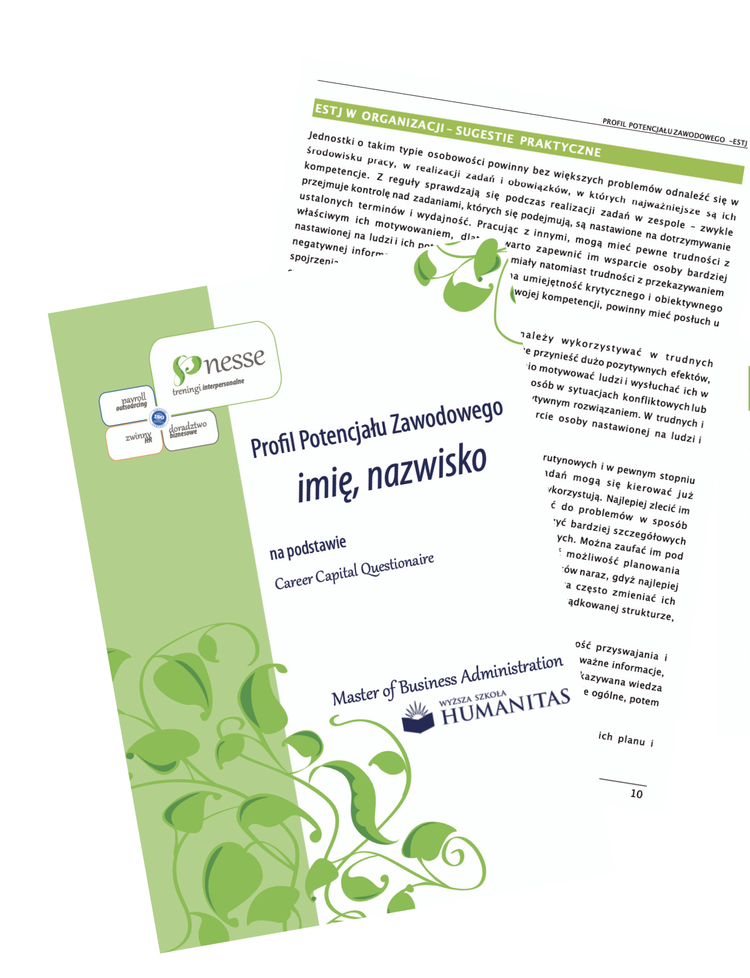
What is the Career Capital Questionnaire?
CCQ (Career Capital Questionnaire) is a psychometric tool that examines a person’s professional potential – not by assessing competencies, but by understanding how their mind, emotions and motivation work.
Unlike many popular personality tests, CCQ doesn’t assign labels or types. Instead, it creates a professional potential profile that shows:
- how a person makes decisions,
- how they respond to change,
- in which professional environment they make the best use of their potential,
- which areas are worth developing to reach full effectiveness.

What is the CCQ methodology based on?
The questionnaire was developed on the basis of contemporary models of personality and temperament psychology and the theory of Carl Gustav Jung. It is based on four key dimensions of human functioning:
- Focus of energy (outer vs inner world),
- Way of gathering information (intuition vs observation),
- Decision-making style (logic vs emotions),
- Preferences in action (structure vs flexibility).
Together, these four dimensions give a coherent picture of how a person thinks, reacts and builds relationships at work.
What does the assessment process look like?
The questionnaire consists of 106 pairs of statements, from which the respondent chooses those that best describe their natural way of acting. The result is then analysed by a certified NESSE consultant, who links the data with the professional context and presents it in a report and a feedback session.
The organisation receives not just a result, but a full interpretation – showing what the preferences mean in business practice.
Why is CCQ reliable?
The tool is fully normed and standardised for Poland, which ensures its psychometric validity and reliability. The assessment meets quality criteria defined by, among others, the European Federation of Psychologists’ Associations (EFPA), and the methodology is regularly verified and adapted to the needs of today’s organisations.
According to a Human Capital Institute report (HCI, 2023), organisations that use highly valid psychometric tools in development processes achieve a 36% higher talent retention rate and 24% better role fit. CCQ is one such tool – supporting HR decisions based on data rather than hunches.
Want this kind of support for your people? It’s ready and waiting.
Write to us. We will arrange a no-obligation conversation and you will find out more.
Your data is processed in line with our Privacy Policy.